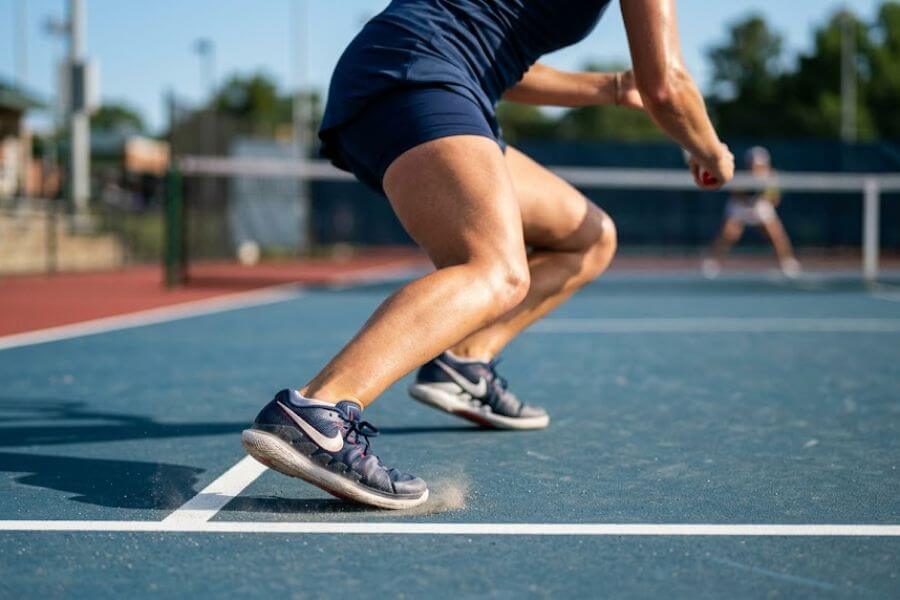
If you want to dominate from the baseline, you need more than just great strokes. You need the ability to glide across the court, change direction effortlessly, and snap back into position after a tough shot. Improving your baseline lateral recovery time allows you to stay in rallies longer, tire out your opponents, and dictate the point. When you shave split seconds off your recovery, you stop scrambling and start controlling the court. The right footwork drills build the muscle memory, explosive power, and balance required to get back to the center of the court before your opponent can exploit an open angle.
Quick Summary of the Best Drills
| Drill Name | Primary Focus | Best Equipment Needed |
| Spider Drill | Multi-directional recovery | Cones |
| Side-to-Side Shuffle | Lateral endurance and low stance | None |
| Carioca Drill | Hip flexibility and quick feet | Agility ladder |
| Cross-Step Recovery | Explosive first-step push | Resistance band |
| Figure-8 Cone Drill | Tight turns and spatial awareness | Two cones |
| Lateral Hop to Sprint | Power and sudden deceleration | Tennis court line |
| Shadow Swings with Bands | Muscle activation under tension | Loop resistance bands |
| Medicine Ball Toss & Recover | Core stability and weight transfer | Medicine ball |
How We Ranked These Footwork Drills
We evaluated dozens of training exercises to find the ultimate routines for baseline recovery. Our ranking process focuses on practical on-court benefits rather than just general fitness. Here are the key factors we considered:
- Direct Transfer to Tennis: How closely the movement mimics an actual match scenario on the baseline.
- First-Step Explosion: The ability of the drill to train your muscles for that crucial initial pushback to the center.
- Injury Prevention: Exercises that strengthen the ankles, knees, and hips to handle sudden stops.
- Accessibility: Drills that require minimal equipment and can be done on any tennis court or open space.
1. The Spider Drill
The Spider Drill is a classic tennis test that challenges your ability to sprint out to various points on the baseline and immediately recover back to the center mark. You start at the middle of the baseline, sprint to a designated cone or line, plant your outside foot, and use low, efficient steps to backpedal or shuffle back to the start. Doing this repeatedly teaches your body how to decelerate quickly and transition your weight smoothly for the return trip, which directly translates to chasing down deep corner groundstrokes.
2. Side-to-Side Shuffle
The Side-to-Side Shuffle keeps things simple but highly effective by forcing you to maintain a low center of gravity while moving parallel to the net. You stay in a athletic wide stance and push off your trailing foot to move across the baseline, ensuring your feet never cross over each other. This drill builds incredible endurance in your quads and glutes, ensuring that you can maintain a wide, stable base even during the third hour of a grueling match.
3. The Carioca Drill
The Carioca Drill improves your hip fluidness and foot speed by requiring you to rapidly cross one foot in front of the other and then behind the other as you move sideways. This quick-stepping pattern improves your foot coordination and forces your hips to rotate dynamically, which is essential when you need to quickly untangle your feet after being pulled wide by a sharp angle. Regular practice creates a level of agility that makes emergency baseline recovery feel completely natural.
4. Cross-Step Recovery Drill
The Cross-Step Recovery Drill focuses specifically on that very first, explosive step you take right after hitting a wide groundstroke. Instead of shuffling back, you actively cross your outside leg over your inside leg to cover a massive amount of ground instantly before transitioning into a standard shuffle. Mastering this specific crossover step is the single fastest way to shave half a second off your recovery time, helping you get back to the center mark before your opponent can hit into the open court.
5. Figure-8 Cone Drill
The Figure-8 Cone Drill uses two markers placed a few feet apart on the baseline to help you practice tight, looping turns and rapid changes of direction. You weave through the cones in a figure-eight pattern, focusing on taking small, rapid adjustment steps as you round the corners and explosive pushes as you accelerate through the straightaways. This constant shifting of weight teaches you how to maintain your balance and stay light on your toes, preventing you from slipping or losing momentum on the court.
6. Lateral Hop to Sprint
The Lateral Hop to Sprint builds the raw, explosive power needed to launch yourself back into the point from a dead stop. You start by balancing on one leg, leap sideways as far as you can onto the other leg, absorb the landing with a bent knee, and instantly push off that foot into a hard sideways shuffle or sprint. This training bridges the gap between pure strength and on-court speed, training your muscles to absorb heavy forces and immediately convert them into forward momentum.
7. Shadow Swings with Bands
Shadow Swings with Bands combine technical stroke mechanics with heavy resistance to supercharge your leg drive. By placing a resistance band around your thighs or ankles while simulating wide forehands and backhands, you force your outer glute muscles to work twice as hard during the recovery phase. Once you take the bands off, your legs will feel incredibly light, and your ability to push off the outside foot after a heavy swing will feel effortless.
8. Medicine Ball Toss and Recover
The Medicine Ball Toss and Recover drill integrates your core strength with your lower-body movement for ultimate stability. As you shuffle to the side, a partner tosses you a medicine ball, or you catch it yourself, catching it precisely as you plant your outside foot to simulate the impact of hitting a heavy tennis ball. Catching and throwing the weight forces you to engage your core and stay upright, preventing your upper body from leaning too far outward and ruining your recovery posture.
Take Your Baseline Game to the Next Level
Improving your lateral recovery time is one of the smartest investments you can make in your tennis game. By consistently practicing these eight drills, you teach your body to move with efficiency, power, and balance. You will quickly notice that you no longer feel rushed between shots and that balls that used to be winners are now well within your reach. Stay dedicated to your footwork training, and watch your confidence grow as you turn your baseline into an unbreachable fortress.
Frequently Asked Questions
How many times a week should I practice these recovery drills to see noticeable results?
To see a real difference in your on-court quickness, you should aim to practice these drills two to three times per week. It is best to do them at the very beginning of your practice session when your mind and muscles are completely fresh, or as a dedicated footwork workout on your off-days. Consistency matters much more than duration, so spending just fifteen to twenty minutes per session focused on high-quality movement will yield great results within a few weeks.
Should I focus more on the crossover step or the side shuffle when trying to get back to the middle?
You actually need to use both steps together for the perfect baseline recovery sequence. The general rule is to use a powerful crossover step first to cover a large amount of distance immediately after your swing, and then transition into smaller side shuffles as you approach the center mark so you can easily change direction for the next shot. The crossover provides the raw speed, while the shuffle provides the balance and control.
Can I practice these lateral movement drills if I am currently recovering from a mild ankle sprain?
You should avoid explosive lateral drills until your ankle is completely healed and you have full medical clearance. Lateral movements place a tremendous amount of sideways stress on your joints, and rushing back into fast cutting motions can easily re-injure weak ligaments. When you are cleared to return, start with slow, controlled side shuffles before moving on to the high-impact hopping and sprinting drills.
Is it better to wear lightweight running shoes or traditional tennis shoes when doing these workouts?
You should always wear proper tennis shoes when performing these baseline drills. Tennis shoes are specifically designed with rigid lateral support and durable outsoles to prevent your foot from rolling over during sharp, sideways movements. Running shoes are meant for forward motion and lack this side-to-side stability, which significantly increases your risk of slipping or twisting an ankle on the court.
Do these footwork exercises help with forward and backward movement or just sideways movement?
While these specific drills are optimized for lateral recovery, the underlying traits they develop, such as calf power, hip flexibility, and foot speed, will absolutely improve your overall court movement. The enhanced body awareness and better balance you gain from training your lateral muscles will make you much more efficient when sprinting forward for short drop shots or tracking backward to smash a deep lob.