Key Takeaways
- Historic Breakthrough: Erling Haaland spearheaded Norway to its first FIFA World Cup appearance since 1998, scoring 16 goals in just 8 qualification matches.
- Staggering Individual Numbers: The Manchester City striker possesses an extraordinary international record, netting 59 goals in 52 appearances for his country.
- Tactical Dependency: Norway remains highly dependent on Haaland for finishing, but a supporting cast featuring Martin Ødegaard and Oscar Bobb proves they have world-class creators.
- The Blueprint for Opponents: As demonstrated by France in the World Cup group stage, limiting service to Haaland or isolating him when he lacks support can completely neutralize the Norwegian attack.
- A Balanced Future: To transition from a top-heavy dark horse to a genuine global power, Norway must develop defensive stability to match their elite forward line.
Introduction: The Weight of a Nation on Giant Shoulders
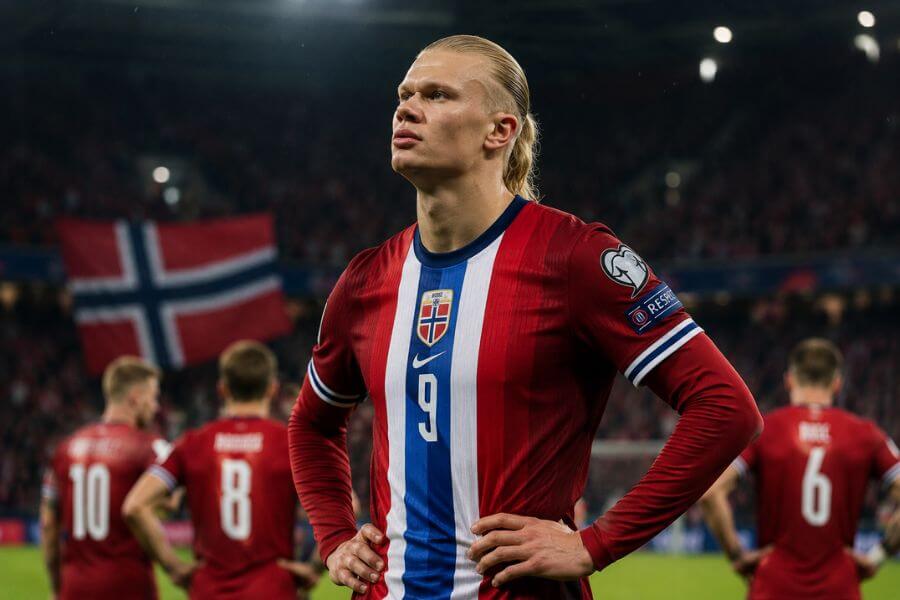
You stand in a crowded stadium, the air crisp and cold, a sea of red and blue jerseys surrounding you. The roar of the crowd is deafening, but all eyes are fixed on a single figure. He stands nearly six feet and four inches tall, with long blonde hair tied back, moving with the explosive power of a sprinter and the hunting instincts of a predator. This is Erling Haaland, the scoring machine who has captivated the football world. For club and country, he does one thing better than almost anyone else in history: he puts the ball in the back of the net.
When you look at the Norway national football team, it is impossible not to focus on him. For years, Norway sat on the sidelines of major international football, missing tournament after tournament, agonizingly close but never quite elite enough to qualify. Then came the rise of their modern talisman. In the qualification cycle for the 2026 FIFA World Cup, Haaland put on a show that defied belief, firing Norway back to the grandest stage for the first time in twenty-eight years.
Yet, this incredible rise brings an uncomfortable question that every football fan, pundit, and tactical analyst is asking. Is Norway too reliant on this single superstar? What happens when an opposing defense manages to lock him down, or when he is rested, as we saw in their recent World Cup group-stage clash against France? You can feel the tension in the air every time Norway takes the pitch. The line between utilizing a world-class asset and becoming dangerously dependent on him is incredibly thin. This deep dive will explore the mechanics of Norway’s tactical setup, the burden placed on Haaland, the quality of his supporting cast, and whether this proud footballing nation can survive when their giant striker cannot carry the load alone.
The Rise of Erling Haaland: A Scoring Phenomenon
To understand whether Norway leans too heavily on Haaland, you must first appreciate the sheer scale of what he brings to the pitch. He is not just a good forward; he is a historic anomaly. His journey from the small Norwegian town of Bryne to the absolute pinnacle of global sports is the stuff of legend. Whether playing in Austria for Red Bull Salzburg, in Germany for Borussia Dortmund, or dominating the English Premier League under Pep Guardiola at Manchester City, Haaland has rewritten the record books.
When he pulls on the national team jersey, that scoring rate does not drop. He has transformed Norway from a team that struggled to break down mid-tier European opponents into a side that can frighten anyone on a given day. His physical gifts are terrifying for defenders: he is faster than most fullbacks, stronger than almost every centerback, and possesses a mental sharpness that allows him to anticipate where the ball will land a second before anyone else.
His impact on the national team is best seen through raw data. Let us take a look at his overall career statistics for Norway to ground our understanding of his massive presence on the pitch.
Erling Haaland Career International Statistics
| Metric | Detail |
| Total Appearances | 52 |
| Total Goals | 59 |
| Goals Per Match Ratio | 1.13 |
| World Cup 2026 Qualification Goals | 16 goals in 8 matches |
| World Cup 2026 Group Stage Goals | 4 goals in 2 matches |
| Consecutive Competitive Scoring Match Streak | 12 matches |
When you study these numbers, the picture becomes clear. Haaland scores at a rate of more than one goal per game for his country. In the high-pressure environment of international football, where teams rarely get to train together and defensive cohesion is hard to build, keeping up a ratio like that is almost unheard of. It is a level of production that alters how games are played. When you have a player who guarantees a goal almost every time he steps onto the field, it changes your entire strategic outlook.
The Qualification Campaign: How Haaland Carried the Burden
The road to the 2026 FIFA World Cup was a historic journey for Norway, a nation that had watched every tournament from home since 1998. The pressure on the squad was immense. For a generation, talented Norwegian players came and went without ever tasting the atmosphere of a World Cup or a European Championship. The public demanded a breakthrough, and the team delivered an unblemished record in qualification: eight wins from eight matches, with an astonishing thirty-seven goals scored.
But when you pull back the curtain on those thirty-seven goals, you see just how heavily the team relied on their star man. Haaland scored sixteen of those goals. That means he was personally responsible for more than forty-three percent of his team’s entire offensive output during the qualifying cycle. Think about that for a moment. In a squad of twenty-six players, one man carried nearly half the goalscoring load.
During this run, the tactical blueprint was clear. Head coach Ståle Solbakken set up the team to maximize Haaland’s strengths. The midfielders were instructed to look for him early, playing direct balls over the top to utilize his pace, or whipping low, hard crosses into the box where he could use his massive frame to bully defenders. It worked perfectly against teams like Moldova, Israel, and Estonia. It even worked in a brilliant away victory against Italy in Milan, where Haaland’s presence pulled the Italian defense out of shape, allowing Norway to secure a famous victory.
However, winning matches in qualification against smaller nations is very different from facing the absolute best in a tournament knockout stage. The heavy reliance on Haaland worked when space was available or when opponents lacked the physical tools to match him. But it also established a predictable pattern of play, one that elite tactical minds could study, dissect, and eventually exploit.
The 2026 World Cup Group Stage: A Tale of Two Realities
The ongoing 2026 World Cup has provided the perfect laboratory to test the theory of Norway’s dependency. Placed in Group I alongside Iraq, Senegal, and powerhouse France, the tournament has shown both the incredible highs of the Haaland effect and the sobering reality of what happens when he is not there or is successfully neutralized.
In the opening match against Iraq in Boston, the world witnessed the classic version of this Norwegian side. Haaland made his tournament debut at the same venue where Diego Maradona played his final World Cup match decades earlier. The occasion did not shake him. He scored twice, leading Norway to a comfortable victory. His movement off the ball left the Iraqi defenders chasing shadows, and his clinical finishing ensured that Norway walked away with three crucial points.
A few days later in East Rutherford, Norway faced a much stiffer test against Senegal. This was a physical, athletic, and tactically disciplined African side that refused to give Haaland an inch of breathing room. Yet, true to his nature, he found a way. While teammate Marcus Holmgren Pedersen opened the scoring, Haaland struck twice in the second half, securing a thrilling victory. By scoring multiple goals in each of his first two World Cup games, he joined an ultra-elite list of football legends, including Just Fontaine and Sandor Kocsis. He also became Norway’s all-time leading scorer in World Cup history in just one hundred and eighty minutes of football.
Then came the final group match against France. With qualification to the Round of 32 already secured, Solbakken made the big decision to rest Haaland, keeping him fresh for the knockout rounds. The result was a wake-up call for Norwegian football fans. Without their star striker leading the line, Norway looked lost in attack. They struggled to hold up the ball, lacked a focal point to stretch the French defense, and eventually crumbled in a heavy defeat. While young midfielder Thelo Aasgaard managed to score a consolation goal, the performance proved that without Haaland, Norway lacks the cutting edge required to compete with the true elite of international football.
To better see the contrast between having Haaland on the pitch versus when he is missing or locked down, let us compare the team’s metrics across these three distinct group-stage encounters.
Norway 2026 World Cup Group Stage Performance Comparison
| Match Opponent | Haaland Status | Team Goals Scored | Total Shots on Target | Attacking Efficiency | Match Outcome |
| Iraq | Played (Scored 2) | 4 | 9 | High | Won 4–1 |
| Senegal | Played (Scored 2) | 3 | 7 | High | Won 3–2 |
| France | Rested (Did Not Play) | 1 | 2 | Low | Lost 1–4 |
This table tells a powerful story. With Haaland on the field, Norway averaged 3.5 goals per match and displayed high efficiency in front of goal. Without him against France, the attack dried up, producing just a single goal from two shots on target. It is clear evidence that while the team can function, their elite status disappears the moment number nine is removed from the equation.
Tactically Unpacking “Haaland-Dependence”
What does it actually mean to be too reliant on one player? In football, tactical dependency occurs when a team’s attacking structures are so intertwined with an individual’s specific skill set that the system fails to function if that player is removed or neutralized. For Norway, this dependency manifests in several clear tactical patterns.
First, consider the concept of space creation. When Haaland is on the pitch, he demands the attention of at least two defenders at all times. No centerback wants to mark him one-on-one. This dual-marking creates natural pockets of space for Norway’s wingers and attacking midfielders. When Haaland makes a darting run toward the near post, he drags the entire defensive line with him, leaving the back post completely exposed for teammates arriving late into the box.
Second, there is the issue of ball progression. Norway often uses Haaland as an escape valve. When the team is pressed high up the pitch by an aggressive opponent, the defenders do not need to take risks playing short passes out of the back. Instead, they can hit a long ball into the opposition half. Haaland’s ability to shield the ball with his body, win aerial duels, and hold off defenders allows Norway to move up the pitch instantly. Without him, a long ball simply results in a loss of possession, forcing Norway to try and build through the midfield, a phase of the game where they can struggle under intense pressure.
The danger of this model is predictability. International managers are masters of video analysis. If an opposing coach knows that every dangerous Norwegian attack must flow through or finish with Haaland, they can design a defensive game plan specifically to stop him. They can deploy a deep defensive block, denying him the space behind the line that he loves to exploit. They can cut off the passing lanes from Norway’s creators, ensuring that the ball never reaches his feet. If you isolate Haaland, you do not just stop a player; you shut down the entire nation’s offensive engine.
The Supporting Cast: Geniuses in the Shadows
It would be deeply unfair to describe the Norway national team as a one-man show. This is not a collection of amateurs playing alongside a superstar. In fact, this is one of the most talented generations of players Norway has ever produced, featuring individuals who play at the absolute highest levels of European club football.
The most prominent of these supporting stars is Martin Ødegaard. As the captain and creative heartbeat of Arsenal in the Premier League, Ødegaard is widely regarded as one of the finest midfield conductors in the world. His vision, passing range, and ability to operate in tight spaces make him the perfect creative partner for Haaland. When you watch Norway play, the connection between Ødegaard and Haaland is often breathtaking. Ødegaard spots the run before Haaland even makes it, delivering pinpoint passes that split open opposing defenses.
Then you have the younger generation of talent breaking through. Oscar Bobb, a technical wizard who plays alongside Haaland at Manchester City, brings unpredictability and dribbling flair to the wings. Antonio Nusa is another young forward with blistering pace and trickery, capable of beating his marker and creating chaos out wide. In midfield, figures like Sander Berge and Patrick Berg provide physical presence and defensive stability, while Jørgen Strand Larsen offers a different option as a powerful central forward.
To see how these key supporting players compare in terms of their roles and club environments, let us look at the structure of Norway’s supporting nucleus.
Key Supporting Players in the Norway National Team
| Player Name | Primary Position | Club Team | Main Tactical Role | Key Attribute |
| Martin Ødegaard | Attacking Midfielder | Arsenal (England) | Creative hub, captain, setting tempo | Vision and passing |
| Oscar Bobb | Winger / Midfielder | Manchester City (England) | Ball retention, driving inside, link play | Dribbling and control |
| Antonio Nusa | Winger / Forward | RB Leipzig (Germany) | Stretching defenses, individual duels | Pace and trickery |
| Sander Berge | Central Midfielder | Fulham (England) | Defensive cover, ball carrying, physical presence | Strength and stamina |
| Jørgen Strand Larsen | Center Forward | Wolves (England) | Alternative target man, aerial option | Hold-up play |
Looking at this list, you realize that Norway has the ingredients to be a balanced, dangerous attacking team even without Haaland. They have elite creation, youthful flair, and physical power in the center of the park. Why, then, does the team still look so vulnerable when Haaland is not performing or is absent? The answer lies not in a lack of talent, but in a lack of goalscoring instinct among the rest of the squad. Ødegaard looks to pass first; Bobb and Nusa look to create space; Berge looks to stabilize. None of them possess that single-minded, ruthless obsession with scoring that defines Haaland. When he is gone, Norway has plenty of chefs in the kitchen, but no one to finish the dish.
The Soft Underbelly: Norway’s Defensive Struggles
While the world focuses on Norway’s star-studded attack, the real reason they are so reliant on Haaland often lies at the other end of the pitch. Norway has a defensive problem. For all their attacking brilliance, they routinely struggle to keep clean sheets against top-tier opposition, and their defensive record is a constant source of anxiety for fans.
During their historical miss of major tournaments prior to 2026, it was rarely a lack of goals that doomed Norway. Instead, it was their tendency to concede soft goals at crucial moments. Even in their successful 2026 World Cup group stage, this pattern was visible. They scored three goals against Senegal but allowed the African side back into the match by conceding two goals, turning what should have been a comfortable victory into a frantic, high-stress finish. Against France, their defensive structures collapsed completely, shipping four goals as the French attackers cut through the backline at will.
This defensive fragility creates a vicious cycle. Because Norway cannot trust their defense to hold a clean sheet or defend a narrow lead, the pressure on the attack to score multiple goals becomes immense. Haaland cannot afford to have a quiet game. If he fails to score two or three times, the team is at serious risk of losing because the defense is highly likely to give up a goal or two.
Therefore, Norway’s reliance on Haaland is not just a tactical choice; it is a survival mechanism. He is the shield that hides their defensive flaws. When he scores a hat-trick, no one talks about the missed tackles or the poor positioning of the centerbacks. But when he is stopped, the soft underbelly of the team is exposed for the whole world to see.
Historical Comparisons: One-Man Teams of the Past
To put Norway’s current situation into perspective, it is helpful to look back at the history of international football. Norway is far from the first nation to possess a singular superstar who towers over the rest of the squad. International football is filled with stories of teams that had to navigate the exact same challenge.
Think of Wales during the peak years of Gareth Bale. Like Haaland, Bale was a world-class athlete who carried his nation to historic tournament appearances, including a famous run to the semifinals of Euro 2016. Wales was undeniably reliant on Bale; he scored the vital goals, took the free kicks, and provided the inspiration. Yet, the Welsh team succeeded because the rest of the squad embraced their role as a disciplined, hard-working defensive unit that kept games tight, allowing Bale to win matches with moments of magic.
Another classic example is Portugal during the early-to-mid career of Cristiano Ronaldo. For years, Portugal possessed a wealth of technical midfielders but lacked a top-tier center forward, forcing Ronaldo to carry an enormous goalscoring burden. Over time, Portugal developed a balanced squad of elite young talents, eventually winning Euro 2016 even after Ronaldo went off injured in the final match.
Let us compare these iconic international setups to see how Norway’s dependency index stacks up against history.
International Superstars and Team Reliance Metrics
| Nation and Player | Era of Dominance | Team Supporting Quality | Defensive Stability | Success Level |
| Wales (Gareth Bale) | 2012–2022 | Moderate / Low | High | Very High (Euro Semifinals) |
| Portugal (C. Ronaldo) | 2004–2018 | High | High | High (Euro 2016 Winners) |
| Argentina (Diego Maradona) | 1986–1994 | Moderate | High | Ultimate (1986 World Cup Winners) |
| Norway (Erling Haaland) | 2020–Present | High (In Attack) | Low | Emerging (2026 World Cup Last 32) |
What this comparison reveals is a crucial difference. Teams like Wales and Argentina won major honors or overachieved because they paired their singular attacking genius with elite defensive stability. Portugal eventually succeeded because their supporting cast stepped out of Ronaldo’s shadow. Norway has the attacking supporting cast, but they completely lack the defensive stability that made those historical teams successful. This makes their reliance on Haaland much more dangerous, as they do not have a solid foundation to fall back on when he has an off day.
Opposing Perspectives: The Arguments For and Against
Is Norway truly too reliant on Haaland, or is this simply the logical way for any team to play when they have the best striker in the world? There are two very distinct schools of thought on this issue, and both present compelling arguments.
The Case For: It is Not Reliance, It is Smart Strategy
Supporters of the current setup argue that labeling Norway as “too reliant” is a misunderstanding of how modern football works. When you possess a player of Haaland’s historic quality, it would be foolish not to build your entire strategy around him. Argentina built around Lionel Messi for two decades; France formats their attack to unleash Kylian Mbappé.
From this perspective, Haaland is doing exactly what he is paid to do. The fact that he scores a large percentage of Norway’s goals is a sign of an efficient system, not a broken one. The supporting players like Ødegaard and Bobb are doing their jobs by feeding him the ball in high-value positions. The team won eight out of eight qualification matches and has reached the knockout rounds of a World Cup. By any objective metric, the strategy is working. To expect Norway to score goals evenly across the squad when they have a generational clinical finisher is simply unrealistic.
The Case Against: A House of Cards Ready to Fall
On the other side of the debate, critics argue that Norway’s current model is a house of cards that will collapse under the pressure of elite tournament football. They point to the France match as definitive proof. When a team is so dependent on one individual, they become fragile. An injury, a red card, or a highly disciplined defensive plan from an opponent can instantly derail their entire tournament journey.
Furthermore, critics argue that this reliance stunts the growth of other players. When younger talents like Nusa or Schjelderup step onto the pitch, they naturally look to pass to Haaland even when better options are available. The team loses its creative freedom because everyone feels an obligation to feed the giant striker. To become a sustainable global football power, Norway must learn to win matches through collective tactical variation, rather than praying for an individual masterclass every ninety minutes.
The Strategic Blueprint: How Norway Can Balance the Scales
If Norway wants to maximize their chances in the knockout rounds of the 2026 World Cup and beyond, they must find a way to balance the scales. They do not need to stop using Haaland, but they must develop tactical alternatives so that his presence becomes a weapon rather than a necessity. Here is a three-step blueprint for how Solbakken and his coaching staff can achieve this balance.
1. Implement a Secondary Attacking System
Norway needs a tactical system that does not rely on a traditional target man. When Haaland is rested or tightly marked, the team should be able to fluidly shift into a fluid, strikerless system or a dynamic front three. Utilizing players like Oscar Bobb, Antonio Nusa, and Andreas Schjelderup in a rotating forward line could create confusion for opposing centerbacks who prefer marking a fixed target like Haaland. This would force opponents to defend the space rather than an individual, opening up passing lanes for Ødegaard to exploit.
2. Diversify the Goalscoring Burden
The midfielders and wingers must become more selfish in the final third. Martin Ødegaard has shown at Arsenal that he can score fifteen goals a season from midfield when he takes responsibility. He needs to bring that same goalscoring mentality to the national team. Wingers must make diagonal runs into the box and look to shoot rather than automatically looking for a cutback to Haaland. If opponents see that Norway’s midfielders are eager to shoot from distance or arrive late in the box, they can no longer afford to double-team Haaland, which ironically will give the star striker even more room to operate.
3. Transition to a Low-Block Defensive Structure
Given Norway’s struggles with defensive pace and positioning, attempting to play a high defensive line against elite nations is a recipe for disaster. Solbakken should consider adopting a compact, disciplined low block when playing top-tier teams. By sitting deep and protecting the penalty area, Norway can minimize their defensive flaws and deny space to quick opposing forwards. This strategy fits perfectly with Haaland’s strengths; a deep defense allows Norway to win the ball back and immediately launch devastating counterattacks, utilizing Haaland’s incredible speed over large distances.
Conclusion: The Ultimate Verdict
So, you are left with the final question: Is Norway too reliant on Erling Haaland? The honest answer is a nuanced one. Yes, tactically and emotionally, Norway leans on their superstar striker to an incredible degree. He is the engine of their offense, the inspiration for their fans, and the primary reason they are currently participating in their first World Cup in nearly three decades. Without him, as the world saw against France, they look like a completely different, much less frightening team.
Yet, to view this simply as a negative dependency is a mistake. Haaland has elevated an entire nation’s footballing culture. He has given confidence to a talented group of supporting players and showed that a country of just five million people can look any football powerhouse in the eye. The challenge moving forward is not to reduce Haaland’s importance, but to elevate the rest of the team’s defensive and tactical maturity to match his world-class standards.
As you watch Norway march into the knockout stages of the 2026 World Cup, you are watching a fascinating football experiment. Can a single, generational superstar carry a proud nation all the way to global glory? With Erling Haaland leading the line, backed by the creative genius of Martin Ødegaard, you can be certain of one thing: it is going to be an unforgettable ride, and no defense in the world will sleep soundly knowing the Striking Viking is waiting for them in the tunnel.
Frequently Asked Questions
Why did Norway fail to qualify for major tournaments for so long before Haaland?
Norway’s long absence from major international football between 1998 and 2026 was primarily due to a lack of elite, world-class goalscoring talent and a persistent struggle with defensive consistency. While Norway produced many solid, hard-working professionals who played in top European leagues, they lacked a clinical, game-changing forward who could turn close draws into victories during high-pressure qualification matches. Additionally, European qualification is notoriously difficult, with only a limited number of spots available for a large pool of highly competitive nations. The arrival of Erling Haaland, alongside world-class creators like Martin Ødegaard, finally gave Norway the elite firepower required to break through the qualification barrier and secure their place on the global stage.
How does Haaland’s scoring rate for Norway compare to his club form at Manchester City?
Haaland’s scoring rate for the Norway national team is remarkably similar to his historic production at the club level. For Manchester City, he routinely averages around a goal per game, benefiting from the world-class service provided by Kevin De Bruyne and a highly refined tactical system under Pep Guardiola. For Norway, his ratio is actually slightly higher, standing at an astonishing 1.13 goals per match. This indicates that despite playing in a less dominant team with far less preparation time, Haaland’s individual brilliance and physical advantages allow him to maintain his clinical efficiency regardless of the shirt he is wearing.
What happened when Norway played France without Haaland in the 2026 World Cup?
During the final group-stage match of the 2026 World Cup, Norway coach Ståle Solbakken chose to rest Erling Haaland, as the team had already secured qualification to the knockout rounds. Facing a powerful French side, Norway struggled immensely without their star forward. The attack lacked a focal point capable of holding up the ball or stretching the French defense, resulting in just two shots on target during the entire ninety minutes. France dominated the match from start to finish, exposing Norway’s defensive vulnerabilities and securing a comfortable 4–1 victory. The match served as a stark reminder of how vulnerable Norway becomes when their talismanic striker is missing from the lineup.
Can Martin Ødegaard carry the team’s creative load if Haaland is successfully locked down by an opponent?
Martin Ødegaard is undoubtedly capable of running the midfield and creating high-quality chances against any defense in the world, as he proves regularly as the captain of Arsenal. However, Ødegaard is a creator rather than a natural goalscorer. If an opponent successfully isolates Haaland or cuts off the passing lanes to him, Ødegaard needs the team’s wingers and secondary forwards to step up and run into the spaces created by the defense’s heavy focus on Haaland. If the rest of the squad fails to make those runs or misses the chances Ødegaard creates, his creative brilliance is minimized, leaving Norway’s attack looking stagnant.
What is the biggest tactical weakness that Norway needs to fix to support Haaland?
Norway’s biggest tactical weakness is their defensive instability. The national team routinely struggles to keep clean sheets against top-tier opponents, often conceding soft goals due to tracking errors, poor positioning, or individual defensive lapses. This defensive fragility puts an immense amount of pressure on Haaland and the attack, as they enter almost every match knowing they likely need to score multiple goals just to secure a victory. To truly maximize Haaland’s prime years and compete for international honors, Norway must develop a more compact, disciplined, and reliable defensive structure that can hold leads when the attack has a quiet afternoon.