Key Takeaway
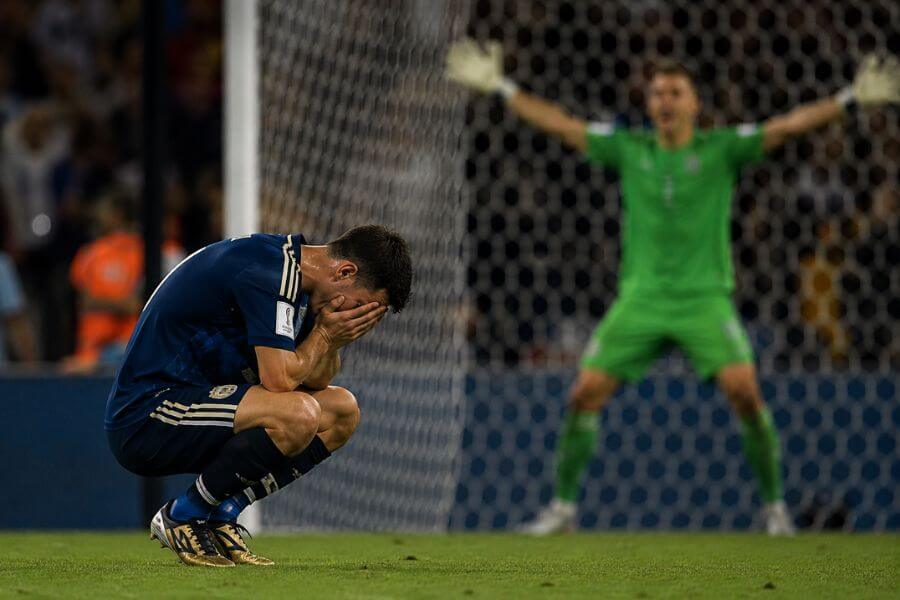
Penalty shootouts are the ultimate test of nerve in soccer. When knockout games tie after one hundred twenty minutes, tactical plans disappear. Winning comes down to pure focus, mental strength, and a bit of luck. The most shocking shootouts in World Cup history prove that even the greatest players can fail when the pressure reaches its peak.
The Mental Battle on the Green Grass
People often say that penalties are just a lottery. They say it is all about luck. But that is not completely true. The physical act of kicking a soccer ball into a large net is something these players do thousands of times in training. Under normal conditions, they could do it with their eyes closed. The real battle happens inside the mind. The goal suddenly looks tiny. The goalkeeper looks giant. The weight of an entire nation rests on a single pair of shoulders.
Goalkeepers hold a special advantage in these moments. Nobody expects them to save every shot. If a ball goes in, people blame the defense or praise the kicker. But if a keeper makes a stop, they become an instant legend. They use mind games to upset the kicker. They dance on the line. They point to one side of the net. They delay the kick by walking away to grab a water bottle. Every second of delay adds more stress to the player waiting to take the shot.
Italy versus Brazil (United States, 1994)
The 1994 World Cup final in the United States was supposed to be a beautiful display of attacking soccer. Instead, it became a grueling tactical war. Italy and Brazil fought under a blazing hot sun at the Rose Bowl in Pasadena. After ninety minutes of regular time and thirty minutes of extra time, neither team could score a single goal. For the first time in World Cup history, the final match would be decided by a penalty shootout.
Italy had a secret weapon, or so everyone thought. Roberto Baggio was the best player in the world at that time. He had carried his team through the tournament with magical goals in the earlier knockout rounds. He was the golden boy of Italian soccer, famous for his creative play and his unique ponytail hairstyle. Even though he was playing with a painful hamstring injury, nobody doubted his ability to score from the penalty spot.
The Missing Stars
The shootout started terribly for both sides. Italy sent up their captain, Franco Baresi. He was a legendary defender who had played a perfect game, but he blasted his shot high over the crossbar. He collapsed to his knees in tears. Brazil’s Marcio Santos went next, but the Italian keeper saved his low effort. The score stayed tied at zero after the first round of kicks.
In the next two rounds, the players found their rhythm. Demetrio Albertini and Alberico Evani scored for Italy. Romario and Branco answered with perfect shots for Brazil. Then came the fourth round. Italy’s Daniele Massaro hit a weak shot that the Brazilian keeper easily blocked. Dunga, the Brazilian captain, stepped up and calmly sent the ball into the back of the net. Brazil was leading three to two.
The Shot That Shocked the World
Everything came down to Roberto Baggio. If he missed, Brazil would win the trophy instantly. Baggio walked slowly to the spot. He adjusted the ball. He took a few steps back. The stadium grew completely silent. He ran forward and struck the ball with his right foot.
Instead of flying into the net, the ball sailed high into the blue California sky. It went way over the crossbar. Baggio stood completely still for several long seconds. He bent his head down, placed his hands on his hips, and stared at the grass. He looked like the loneliest man on earth. Behind him, the Brazilian players erupted in wild celebration. It remains the most famous miss in the history of sports.
England versus Argentina (France, 1998)
The rivalry between England and Argentina is always intense, both on and off the field. Their Round of 16 match in the 1998 World Cup was an instant classic. It had everything. A wonder goal by a young Michael Owen, a red card for David Beckham after he kicked an opponent, and a fierce battle that ended in a two to two tie. Extra time could not separate them, so the teams faced a shootout in Saint Etienne.
England entered the shootout with a historical dark cloud hanging over their heads. They had lost a painful shootout to Germany in the 1990 World Cup semifinals. They had also lost to Germany on penalties in the 1996 European Championship. The English public feared shootouts, and that fear had clearly spread to the players. Argentina, on the other hand, felt confident. They had a history of winning these intense mental battles.
Goalkeeping Heroes
Alan Shearer scored first for England with a powerful shot into the top corner. Sergio Berti matched him for Argentina. Then, the tension began to twist the stomachs of the fans. Paul Ince stepped up for England. He hit a solid shot toward the left post, but Argentine goalkeeper Carlos Roa made a spectacular diving save. England’s old nightmare was returning.
Argentina had a chance to take a major lead, but Hernan Crespo saw his shot saved by English keeper David Seaman. The English fans cheered wildly. Hope was alive again. Standard goals followed from unheralded players on both sides.
The Final Blow
- Round Three: David Beckham’s absence was felt, but Tony Adams scored safely. Juan Sebastian Veron scored a rocket for Argentina.
- Round Four: Paul Merson scored a brilliant penalty for England. Marcelo Gallardo scored for Argentina despite the keeper touching the ball.
- Round Five: David Batty stepped up for England. He had to score to keep his team alive.
Batty was a tough midfielder, but he was not a regular penalty taker. You could see the doubt in his eyes as he approached the ball. He hit a central shot that lacked real power. Carlos Roa guessed correctly, dived to his left, and punched the ball away. Argentina advanced, and England was left to mourn another shootout disaster.
France versus Italy (Germany, 2006)
The 2006 World Cup final in Berlin was a rematch of old European rivals. It will always be remembered for one shocking moment in extra time. Zinedine Zidane, the French captain and superstar, headbutted Italian defender Marco Materazzi in the chest. The referee showed Zidane a red card. The greatest player of his generation walked past the World Cup trophy and into the locker room, leaving his ten teammates to fight without him.
Without their leader and best penalty kicker, France looked shaken. Italy was highly motivated. They wanted to erase the bad memories of their 1994 shootout loss to Brazil. They also wanted to forget their shootout losses in 1990 and 1998. The Italians were determined to prove they could handle the ultimate pressure.
Accuracy from the White Spot
Italy batted first. Andrea Pirlo, the cool midfield master, chipped his shot straight down the middle. Sylvain Wiltord answered for France with a calm finish. In the second round, Marco Materazzi scored for Italy. He had been at the center of every major event in the game, scoring Italy’s regular goal and getting Zidane sent off.
Then came David Trezeguet for France. He was a fantastic striker, but he had a complicated history with the Italian goalkeeper, Gianluigi Buffon, because they played for the same club team in Italy. Trezeguet ran up and hit a powerful shot. It beat the keeper but slammed directly into the bottom of the crossbar. The ball bounced straight down, hit the grass outside the goal line, and spun away. It was a matter of inches.
Perfect Execution
Italy did not give France any room to recover. Every single Italian kicker performed their job with absolute perfection.
- Daniele De Rossi blasted his shot into the roof of the net.
- Eric Abidal scored for France to keep them close.
- Alessandro Del Piero calmly fooled the keeper for Italy’s fourth goal.
- Willy Sagnol scored a powerful shot for France.
Fabio Grosso stepped up to take the fifth penalty for Italy. He was an unexpected hero of the tournament, having scored a crucial goal in the semifinal against Germany. Grosso ran up and drove the ball into the top right corner. The French keeper went the wrong way. Italy had scored all five of their penalties to win their fourth World Cup title.
Ghana versus Uruguay (South Africa, 2010)
The 2010 World Cup in South Africa was historic because it was the first time the tournament was held on the African continent. Ghana became the pride of Africa by reaching the quarterfinals. They were playing against Uruguay in Johannesburg, and they were just seconds away from becoming the first African team to ever reach a World Cup semifinal.
In the final minute of extra time, with the score tied at one to one, Ghana launched a massive attack. A header was flying into the Uruguay net. Out of nowhere, Uruguayan striker Luis Suarez used both of his hands to slap the ball off the goal line. It was a clear violation of the rules. The referee immediately sent Suarez off with a red card and awarded Ghana a penalty kick.
The Crossbar Heartbreak
Asamoah Gyan stepped up to take the penalty. If he scored, the game would end immediately, and Ghana would make history. Gyan was an excellent striker who had already scored two penalties in the tournament. He struck the ball firmly, but it hit the top of the crossbar and flew into the stands. Luis Suarez, who was watching from the stadium tunnel, celebrated wildly. The referee blew the final whistle. The match went to a shootout.
The mental damage to Ghana was immense. They had won the game, and then they had lost it in a fraction of a second. Gyan showed incredible courage by stepping up to take the very first penalty of the shootout, and this time he scored. But his teammates could not shake off the dark feelings from the missed opportunity.
The Cheeky Finish
Uruguay looked relaxed during the shootout. Their goalkeeper, Fernando Muslera, made two excellent saves against John Mensah and Dominic Adiyiah. The defining moment came down to Uruguay’s veteran forward, Sebastian Abreu. He had the chance to win the match with his team’s fifth kick.
Instead of hitting a standard power shot, Abreu did something incredibly risky. He used a technique called the Panenka. He ran up fast, then gently chipped the ball down the middle of the goal as the keeper dived to the side. The ball floated slowly through the air and landed softly in the net. It was a shockingly confident move that broke African hearts and sent Uruguay to the semifinals.
Netherlands versus Costa Rica (Brazil, 2014)
The 2014 quarterfinal between the Netherlands and Costa Rica was a classic clash between a global soccer giant and a surprising underdog. Costa Rica had shocked everyone by surviving a group with Uruguay, Italy, and England. They defended with incredible discipline against a powerful Dutch attack led by Arjen Robben and Robin van Persie.
The game remained scoreless through ninety minutes and all of extra time. Costa Rica’s goalkeeper, Keylor Navas, was playing like a wall. He stopped every single shot that came his way. As the clock ticked down toward the hundred twentieth minute, everyone assumed the shootout would favor Costa Rica because their keeper was in such amazing form.
The Tactical Gamble
With just seconds left before the end of extra time, Dutch coach Louis van Gaal made a move that had never been seen before in World Cup history. He took off his starting goalkeeper, Jasper Cillessen, and replaced him with the reserve goalkeeper, Tim Krul. Krul was taller and had a longer reach, but he was not known as a penalty specialist. It was a massive gamble that could have made the coach look foolish if it failed.
Tim Krul entered the field with an aggressive attitude. As soon as the shootout began, he started using intense psychological tricks. Before every Costa Rican kick, Krul walked up to the player, stared directly into their eyes, and told them that he knew where they were going to shoot. He walked along the goal line, waving his arms and making himself look as large as possible.
The Plan Works
The mental pressure completely disrupted the Costa Rican players. They were used to the quiet style of Cillessen, and Krul’s loud behavior threw them off balance.
- Bryan Ruiz stepped up for Costa Rica’s second kick. Krul dived to his left and blocked the ball.
- The Dutch kickers were perfect, scoring all four of their shots with absolute confidence.
- Michael Umana took the fifth kick for Costa Rica. He needed to score to keep his team alive.
Krul once again guessed the correct side. He lunged to his right and slapped the ball away with his strong hands. He turned and ran across the field to celebrate with his teammates. The tactical genius of Louis van Gaal had worked perfectly, and the Netherlands advanced to the semifinals without their starting keeper playing a single second of the shootout.
Croatia versus Brazil (Qatar, 2022)
Brazil entered the 2022 World Cup in Qatar as the heavy favorite to win the entire tournament. They had a squad filled with expensive superstars and played beautiful, flowing soccer. In the quarterfinals, they met Croatia, a small nation with a reputation for never giving up. Croatia had reached the final in 2018 by winning multiple overtime games and shootouts.
For ninety minutes, Croatia slowed down the Brazilian attack with a masterclass in midfield passing led by the veteran Luka Modric. In extra time, Neymar scored a breathtaking goal that seemed to win the match for Brazil. But Croatia refused to die. In the hundred seventeenth minute, Bruno Petkovic scored a dramatic equalizer. The Brazilian players looked stunned. They had victory in their hands, and it had slipped away.
The Wall of Zagreb
Croatia had a massive mental advantage going into the shootout. Their goalkeeper, Dominik Livakovic, had already saved three penalties in the previous round against Japan. He looked calm, focused, and completely unbeatable. Brazil looked nervous. Their regular flow had been broken, and they were suddenly facing a high pressure lottery.
Croatia batted first, and Nikola Vlasic blasted his shot straight down the middle. Brazil sent up Rodrygo, a talented young forward. Rodrygo looked tense as he approached the ball. He hit a weak, medium height shot to the left side. Livakovic read it perfectly, leaped through the air, and batted it away. Brazil was instantly chasing the game.
The Final Mistake
Croatia showed no mercy. Lovro Majer, Luka Modric, and Mislav Orsic all converted their penalties with extreme precision. They did not give the Brazilian keeper any chance. Marquinhos stepped up for Brazil’s fourth kick. If he missed, the tournament was over for the favorites.
Marquinhos tried to hit the ball hard into the corner. He beat the keeper, but the ball crashed against the base of the left post with a loud thud. It bounced away into the penalty box. The Croatian players ran from the midfield line to jump on top of Livakovic. The pre tournament favorites were going home early, proved wrong by a tiny nation that simply refused to lose a shootout.
Historical Shootout Data and Outcomes
To understand how shocking these moments are, it helps to look at the numbers. Certain countries have built a reputation for winning these events, while others seem cursed by them. The table below provides a clear look at how different nations have performed in World Cup shootouts over the decades.
| Country | Shootouts Played | Shootouts Won | Shootouts Lost | Winning Percentage |
| Argentina | 7 | 6 | 1 | Eighty Six Percent |
| Croatia | 4 | 4 | 0 | One Hundred Percent |
| Germany | 4 | 4 | 0 | One Hundred Percent |
| Brazil | 5 | 3 | 2 | Sixty Percent |
| Italy | 4 | 1 | 3 | Twenty Five Percent |
| England | 4 | 1 | 3 | Twenty Five Percent |
The data reveals a stark contrast. Teams like Germany and Croatia have perfect records, which points to excellent mental preparation and technical execution. Meanwhile, powers like Italy and England have historically suffered, though Italy did manage to win the big one in 2006.
Comparing the Greatest Penalty Misses
Not all penalty misses are created equal. Some happen early in a shootout, leaving time for a team to recover. Others happen at the very end, causing immediate elimination. The table below compares the most shocking individual misses from the games discussed above, highlighting the round, the score at the time, and the immediate result of the mistake.
| Player Name | Tournament and Round | Opponent | Type of Miss | Impact of Miss |
| Roberto Baggio | 1994 Final | Brazil | Over the Crossbar | Immediate Elimination |
| Paul Ince | 1998 Round of 16 | Argentina | Goalkeeper Save | Lost Advantage |
| David Trezeguet | 2006 Final | Italy | Hit the Crossbar | Lost the Final |
| Asamoah Gyan | 2010 Quarterfinal | Uruguay | Hit the Crossbar | Match Went to Shootout |
| David Batty | 1998 Round of 16 | England | Goalkeeper Save | Immediate Elimination |
| Marquinhos | 2022 Quarterfinal | Brazil | Hit the Goalpost | Immediate Elimination |
This comparison shows that hitting the woodwork or shooting over the bar is often the result of trying to be too precise because of the fear of the goalkeeper making a save.
Frequently Asked Questions
When was the very first penalty shootout introduced in the World Cup?
The penalty shootout rule was adopted by FIFA in 1970, but it did not actually happen in a tournament until 1982. The first World Cup match decided by penalties was the semifinal between West Germany and France in Spain. West Germany won that shootout after a thrilling three to three tie in extra time.
Which individual player has scored the most goals in World Cup shootouts?
Several players have scored multiple times in shootouts across different World Cups. Ivan Rakitic of Croatia and Lionel Messi of Argentina are among the rare players who have successfully converted penalties in multiple shootouts during a single tournament, showing incredible mental strength.
Can a coach change the goalkeeper specifically for a penalty shootout?
Yes, a coach can substitute the goalkeeper at any point during regular play or extra time, provided the team has not used all of their allowed substitutions. As seen with the Netherlands in 2014, this tactic can be highly effective if the replacement keeper is well prepared and can disrupt the focus of the opposition.
What happens if all eleven players take a penalty and the score is still tied?
If every player on the field has taken a kick and the score remains even, the shootout loops back to the very first kicker. The teams will continue to take alternating penalties in a sudden death format until one team scores and the other misses.
Are goalkeepers allowed to move along the goal line before the ball is kicked?
Goalkeepers are allowed to move laterally or jump up and down on the line to try and distract the kicker. However, according to modern rules, they must have at least part of one foot touching, or in line with, the goal line at the exact moment the ball is struck. They cannot move forward off the line early.