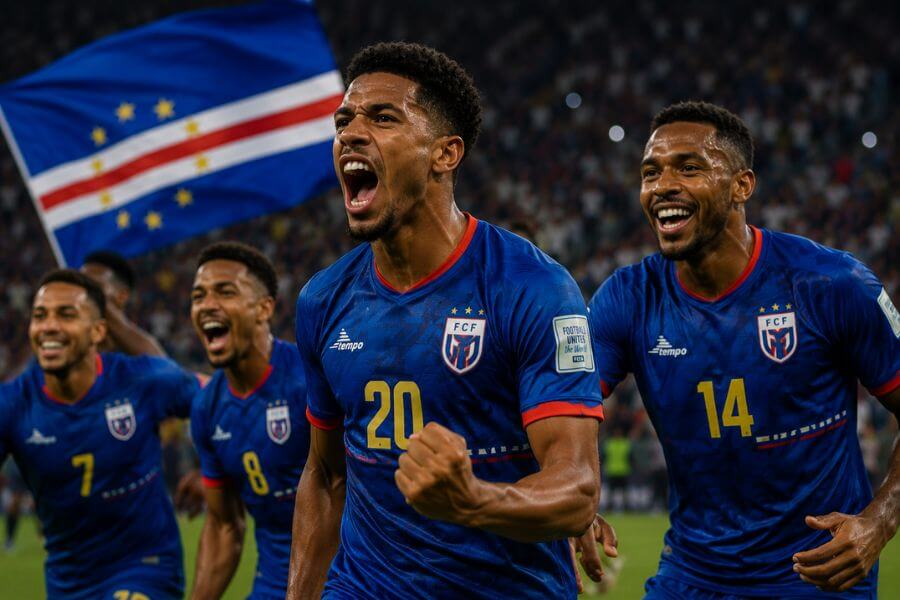
Key Takeaways
Before diving into the incredible journey of Cape Verde, here are the core lessons from their historic run that shook the soccer world.
- Preparation Trumps Reputation: Small nations can overcome deep-rooted soccer giants through meticulous planning, tactical discipline, and strong team chemistry.
- The Power of Unity: A squad playing with a shared sense of identity and national pride can outshine a group of highly paid individual superstars.
- Strategic Recruiting: Leveraging global diaspora networks allows smaller countries to build competitive, top-tier international rosters.
- Tactical Flexibility: Success against diverse opponents requires the ability to switch seamlessly between a low-block defense and a high-pressing attack.
Imagine standing on the edge of a massive soccer field. The lights are blinding, the crowd is a roaring sea of sound, and across from you stand players whose names are worth millions of dollars. They play for the biggest clubs in Europe. They have trophies, fame, and history on their side. Now look down at your own jersey. You represent a tiny group of volcanic islands in the middle of the Atlantic Ocean. Most people could not find your country on a map. The experts gave you a zero percent chance to survive the opening round.
Yet, within ninety minutes, everything changes.
This is not a movie script. This is the real-world story of the Cape Verde national soccer team, affectionately known as the Blue Sharks. Their recent performance in the continental tournament group stage did more than just turn heads. It shattered expectations, rewrote history books, and provided a masterclass in how an underdog can dominate the biggest stage. If you love stories about passion, strategy, and overcoming impossible odds, you are in the right place. Let us take a deep dive into how Cape Verde pulled off one of the greatest group-stage shocks in modern soccer history.
The Island Nation Nobody Saw Coming
To understand the scale of this achievement, you first need to understand where Cape Verde is coming from. Geographically, it is a small archipelago of ten volcanic islands located about three hundred fifty miles off the coast of West Africa. The total population fluctuates around five hundred thousand people. In soccer terms, that is a tiny talent pool compared to nations with tens of millions of citizens.
Historically, Cape Verde was never a major player in international tournaments. For decades, their team struggled just to qualify for regional matches, let alone compete with the heavyweights of the continent. They were often viewed as an easy draw, a team that bigger countries could play against to boost their goal differential.
But soccer is beautiful because history does not play the game; eleven humans on a field do. Over the past decade, a quiet revolution took place within Cape Verdean sports. The local federation began investing in better coaching, tracking down players with Cape Verdean heritage living across Europe, and building a distinct style of play. By the time they arrived at this tournament, the Blue Sharks were no longer just happy to be there. They came with a plan.
Deconstructing the Group of Death
When the tournament draw came out, soccer analysts around the world immediately sighed with pity for Cape Verde. They were placed in a group alongside two of the absolute titans of continental soccer: Egypt and Ghana. To round things out, they also had to face Mozambique, a physical and highly unpredictable team.
Let us look at the massive gap between Cape Verde and their primary group opponents prior to the tournament starting.
The Group Stage Landscape
| Country | Population | Past Continental Titles | Key Star Players |
| Egypt | Over 100 Million | 7 Titles | Premier League Stars, Elite Forward |
| Ghana | Over 30 Million | 4 Titles | Midfield Anchors, French League Wings |
| Mozambique | Over 30 Million | 0 Titles | Domestic League Stars, Tough Defenders |
| Cape Verde | 500 Thousand | 0 Titles | Global Journeymen, Cohesive Team Units |
On paper, this was not a competition; it was an execution. Egypt brought world-class attacking power. Ghana brought physical dominance and a roster filled with English Premier League talent. Cape Verde brought a roster of players who mostly played for mid-tier clubs in countries like Portugal, Cyprus, and Azerbaijan. The narrative was set before a single ball was kicked. Everyone expected Egypt and Ghana to stroll into the knockout rounds, leaving Cape Verde and Mozambique to fight for scrap pieces.
Match One: The Night Ghana Stood Still
The opening match of the group stage set the tone for the entire tournament. Cape Verde walked onto the pitch to face Ghana, a team known for its aggressive style and rapid counter-attacks. From the first whistle, you could see that Cape Verde was not afraid. They did not sit back in a defensive shell. Instead, they took the fight directly to Ghana.
The Blue Sharks utilized a high-pressing system that caught the Ghanaian midfielders completely off-guard. Cape Verde scored early, shocking the stadium into absolute silence. A rebound from a sharp shot found the foot of a Cape Verdean forward, who calmly slotted it home.
Ghana fought back, using their physical strength to equalize in the second half. In the past, a goal like that would cause a smaller team to crumble under pressure. But this Cape Verde team showed an incredible amount of mental resilience. They kept passing, kept moving, and kept believing.
The Defining Moment
As the clock ticked into stoppage time, disaster struck for Ghana. A defensive mix-up left the ball bouncing loose inside the penalty box. A Cape Verdean substitute, showing incredible hunger, anticipated the mistake, sprinted past the static defenders, and poked the ball into the net.
The stadium erupted. The bench cleared. Cape Verde had not just survived; they won the match two-to-one. It was their first-ever victory over Ghana, and it instantly flipped the entire group on its head.
Match Two: Crushing Expectations Against Mozambique
After a historic win against a giant like Ghana, the biggest danger for any underdog team is complacency. It is common for a team to experience an emotional hangover, losing focus in the very next match. Cape Verde faced Mozambique in a game that many fans felt would reveal whether the Blue Sharks were the real deal or just a one-hit wonder.
Tactically, this match required a completely different approach. Mozambique was not going to give Cape Verde the space to counter-attack. They wanted a muddy, slow, physical battle.
The Cape Verdean coach showed great wisdom by adjusting his tactics. Instead of a furious press, they focused on controlled possession and long-range shooting to unlock a stubborn defense.
Key Match Statistics
- Total Shots: Cape Verde 17, Mozambique 5
- Shots on Target: Cape Verde 7, Mozambique 1
- Possession Percentage: Cape Verde 58%, Mozambique 42%
- Passing Accuracy: Cape Verde 84%, Mozambique 71%
The strategy worked perfectly. A spectacular forty-yard free kick opened the scoring for Cape Verde, a strike so powerful that the opposing goalkeeper could only help it into the top corner.
Instead of letting up, Cape Verde pushed harder in the second half, scoring two more goals to secure a dominant three-to-zero victory. With six points in the bag, Cape Verde did something no one thought possible: they qualified for the knockout round with a game to spare, securing the top spot in the group.
Match One vs Match Two Tactical Shift
To understand how impressive this run was, look at how the team altered its style depending on the opponent.
Tactical Comparison
Pressing Intensity
- Against Ghana: Extremely High. Pressed defenders in their own penalty box to force turnovers.
- Against Mozambique: Medium-Low. Allowed defenders to have the ball, focusing on winning it in midfield.
Passing Style
- Against Ghana: Direct and Fast. Quick wing play utilizing vertical balls to exploit space behind fullbacks.
- Against Mozambique: Patient and Lateral. Swapping the ball side-to-side to pull a compact defense out of position.
Defensive Shape
- Against Ghana: Compact Four-Four-Two block to deny space to star midfielders.
- Against Mozambique: Fluid Four-Three-Three system that pushed outside-backs high up the field.
Match Three: A Thriller with Egypt
With the first place in the group already locked up, Cape Verde could have rested all their star players and taken a peaceful loss against Egypt. Egypt desperately needed a win to guarantee their own survival. But the Blue Sharks possessed a fierce competitive spirit. They wanted to prove that their success was not a fluke.
What followed was one of the most chaotic, entertaining matches of the decade. Cape Verde took the lead right before halftime, shocking Egypt with a brilliant turn-and-shoot inside the box. Egypt responded with immense pressure in the second half, scoring two goals to take a two-to-one lead late into injury time.
Egypt thought they had secured the win and saved their tournament life. But you can never count out the Blue Sharks. In the ninety-ninth minute, a brilliant cross found a Cape Verdean attacker at the back post, who controlled it and smashed it past the goalkeeper to tie the game at two-two.
The draw meant Cape Verde finished the group stage completely undefeated. They stood proud at the top of the standings, leaving two of Africa’s biggest soccer nations scrambling for survival behind them.
The Secret Architecture of the Blue Sharks
How did this happen? How does a nation with the population of a small European city outplay countries with millions of resources? The answer lies in the unique structure of the Cape Verdean squad and their specific soccer philosophy.
The Global Diaspora Network
Cape Verde has a unique demographic reality. There are actually more people of Cape Verdean descent living outside of the islands than on the islands themselves. Large communities exist in Portugal, New England, France, and the Netherlands.
In the past, players born in these communities dreamed of playing for France or Portugal. But the Cape Verdean soccer federation changed its approach. They built a world-class scouting network to find these players early in their careers. They did not just sell them on soccer; they sold them on heritage, family, and the chance to build a legacy.
This strategy allowed them to field a team composed of players who trained in elite European academies. When you combine European tactical education with the fierce pride of representing your ancestral homeland, you get a highly dangerous soccer team.
The No-Superstar Philosophy
Look at Egypt, and you see a team built around a single iconic winger. Look at Ghana, and you see individual stars who command massive transfer fees. Look at Cape Verde, and you see a collective unit.
There are no massive egos in the Blue Sharks locker room. If a player does not track back to defend, they do not play. Their scoring load is spread evenly across the entire front line. In this group stage, their seven goals were scored by six different players. This makes them incredibly difficult to defend against because opposing coaches cannot simply man-mark one star player out of the game.
The Mastermind on the Sidelines
Every great soccer story needs a brilliant manager, and Cape Verde found theirs in Bubista. A former national team captain himself, Bubista understands the psychology of the Cape Verdean player better than anyone else. He did not try to copy the style of Spain or Brazil. He built a system tailored specifically to the strengths of his roster.
Bubista realized that his players were naturally quick, agile, and possessed excellent stamina. He designed a defensive system that relies on constant communication and lateral shifting. When the opponent has the ball, Cape Verde shrinks the field, leaving zero space in the central midfield.
When they win the ball back, they expand instantly, using lightning-fast wingers to stretch the opposing defense. His calm demeanor on the sideline provided a sense of stability when matches became chaotic, particularly during the high-stress final minutes against Ghana and Egypt.
The Cultural Impact Across the Archipelago
To truly understand what this group-stage run means, you have to look beyond the soccer field. You have to look at the streets of Praia, Mindelo, and the diaspora communities in Boston and Lisbon.
During every match, life on the islands ground to a complete halt. Businesses closed early. Huge projector screens were set up in public squares. People gathered in the thousands, wearing the vibrant blue and red colors of the national flag.
For a country that often struggles with economic isolation and geographic separation, soccer became a powerful unifying glue. The victories brought a profound sense of international visibility and national self-esteem.
The players became national heroes, proving to the youth of Cape Verde that coming from a small island does not mean your dreams have to be small. The economic boost from jersey sales, tourism interest, and tournament prize money will help fund local soccer academies for the next generation.
Frequently Asked Questions
Had Cape Verde ever qualified for this tournament before their historic run?
Yes, Cape Verde had qualified for the tournament a few times in their past history. They made their debut in 2013, where they surprisingly reached the quarterfinals, and they also appeared in 2015 and 2021. However, their performance in this specific tournament group stage was completely unprecedented because they had never won their group before, remained entirely undefeated, or dominated soccer giants like Ghana and Egypt so convincingly.
How do soccer scouts find players for Cape Verde if the population is so small?
The scouting system relies heavily on tracking the global Cape Verdean diaspora. Because millions of Cape Verdeans live abroad, scouts monitor youth leagues in countries like Portugal, France, the Netherlands, and the United States. They look for talented players who have parents or grandparents born in Cape Verde. Once identified, the federation reaches out to connect these athletes with their heritage, offering them a chance to play international soccer.
Which player scored the most goals for Cape Verde during the group stage?
One of the most impressive parts of Cape Verde’s run was their lack of reliance on a single goal-scorer. Their seven total goals during the group stage were divided among six different players. This balanced attack made it impossible for opponents to shut them down by focusing on just one star athlete. It proved that their success was a true team effort rather than the result of an individual standout performance.
Did Cape Verde change their manager before this tournament started?
No, Cape Verde kept their trusted manager, Bubista, who has been leading the team through a long-term development plan. Bubista is a former captain of the national team, meaning he brought deep personal pride and structural stability to the squad. His familiarity with the players and his clear tactical blueprint were major reasons why the team looked so organized and confident against far wealthier opponents.
What happened to Ghana and Egypt after playing against Cape Verde?
Cape Verde’s incredible performance threw the entire group into chaos for the traditional powerhouses. Because Cape Verde locked up the top spot so early, Ghana was eliminated from the tournament entirely during the group stage, causing a massive national controversy back home. Egypt barely survived, managing to squeeze into the next round as the second-place team without winning a single game, showing just how much Cape Verde disrupted the status quo.