Key Takeaway
The 2026 FIFA World Cup final concludes with an unprecedented dual trophy presentation featuring United States President Donald Trump and FIFA President Gianni Infantino. This moment marks a major shift from recent soccer traditions, combining massive global sports entertainment with high-stakes political branding. By understanding this partnership, you can see how sports mega-events serve as powerful tools for international diplomacy, personal legacy building, and corporate control.
The Global Stage Meets the Ultimate Power Play
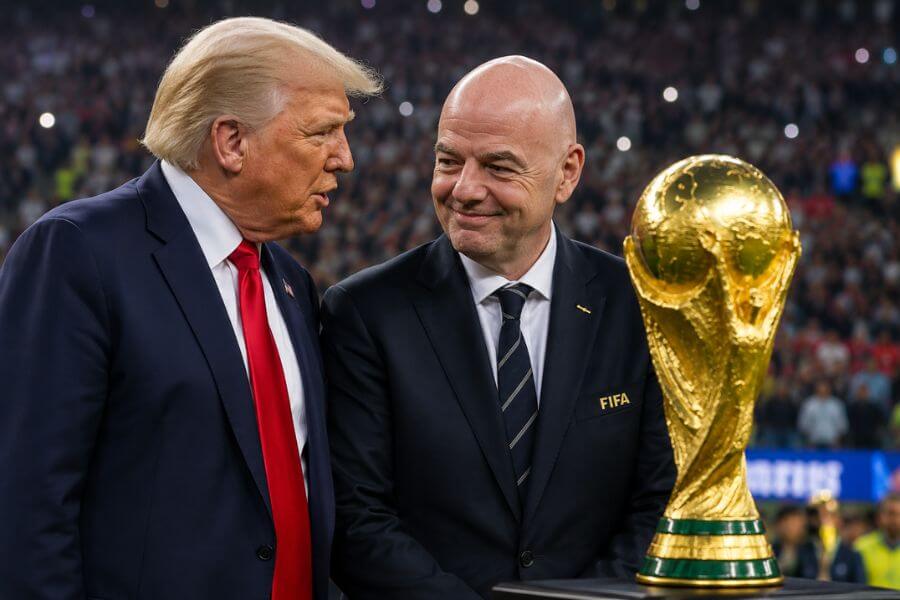
For decades, the World Cup trophy presentation followed a strict, predictable script. The head of soccer’s global governing body would hand the prize to the winning captain, perhaps flanked by local royalty or a low-key head of state who quickly stepped aside. This year, the script is completely flipped. Gianni Infantino has confirmed that he and Donald Trump will stand shoulder-to-shoulder, handing over the trophy together and remaining on the podium during the peak celebration.
This is not a casual sports ceremony. It is a calculated, carefully planned political statement. When you watch this presentation, you are seeing how modern leaders use the massive cultural weight of sports to shape their public images. The trophy itself becomes a secondary prop in a much bigger game of global influence, media dominance, and corporate strategy.
The Evolution of the Soccer Podium
To understand how you arrived at this moment, you need to look back at the history of sports trophy presentations. The relationship between politicians and sports champions has always been a delicate dance. In the past, world leaders used these moments to project national unity or celebrate athletic excellence without completely overshadowing the game.
Historical Presentations of Note
- 1966 World Cup: Queen Elizabeth II presented the Jules Rimet Trophy to England captain Bobby Moore at Wembley Stadium, creating an iconic image of royal celebration that defined British pride for a generation.
- 1982 World Cup: King Juan Carlos of Spain handed the trophy to Italian captain Dino Zoff, showing a smooth transition of democratic hospitality on European soil.
- Modern Era: In recent tournaments like Russia 2018 and Qatar 2022, FIFA presidents took full ownership of the podium, making the presentation an exclusive corporate branding moment for the soccer organization.
The 2026 arrangement breaks directly from recent protocol. Under former leadership, the soccer organization guarded its podium fiercely to maintain an image of political neutrality. By bringing a sitting United States president into the center of the celebration, the current management is openly embracing a new era where political alignment and sports entertainment are fully mixed.
A Friendship Built on Big Business
The partnership between Donald Trump and Gianni Infantino did not happen overnight. You can trace this connection back to the first Trump administration, when the joint United States-Canada-Mexico bid won the hosting rights for this expanded forty-eight-team tournament. Over the years, the two leaders have built a highly visible, mutually beneficial relationship that defies standard diplomatic norms.
Highlights of the Partnership
- White House and Mar-a-Lago Meetings: The soccer chief has been a frequent guest at the Oval Office and the Florida estate, exchanging personalized jerseys, custom soccer balls, and symbolic referee cards.
- Davos Introduction: In 2020, the soccer head offered a highly flattering introduction for the American president at the World Economic Forum, praising his business vision and leadership.
- The FIFA Peace Prize: In late 2025, the soccer body awarded the president its inaugural Peace Prize, citing his work in international mediation, a move that heavily signaled their deep alliance ahead of the summer tournament.
This close tie has sparked plenty of talk in the sports world. Critics argue that the soccer organization is violating its own rules regarding political neutrality. However, from a practical standpoint, hosting a tournament of this scale across three massive nations requires intense federal support. For the soccer head, having a direct line to the White House helps clear major hurdles involving airport security, border crossings, and stadium logistics.
The Club World Cup Warning Sign
If you want a preview of how the 2026 final might look, you only need to look back at the recent Club World Cup final held in the United States. During that tournament, Chelsea secured the title, and the American president joined the presentation stage. What was supposed to be a standard hand-off turned into a viral, heavily debated media event.
Instead of stepping back to let the players celebrate, the president remained dead center on the podium, standing right next to captain Reece James as the confetti fell. The move caught several players completely off guard. Forward Cole Palmer later admitted he was confused by the setup, expecting the politician to exit before the trophy lift.
The crowd reaction was just as divided, filled with a loud mix of cheers and boos. This moment proved that the global sports audience does not leave domestic politics at the stadium gate. When you bring a polarizing leader onto the championship stage, the sports celebration instantly splits along political lines, turning a unifying athletic achievement into a fierce debate about branding and visibility.
The Host Nation Strategy
For the American president, the World Cup final represents the ultimate public relations opportunity. While he skipped early group-stage matches, including the opening games in Los Angeles, his choice to claim the final match fits perfectly with a long-term sports strategy. He has consistently used high-profile sports events, from the Super Bowl and Ultimate Fighting Championship matches to the Ryder Cup, to connect directly with massive crowds.
The President’s Sports Playbook
| Event Type | Typical Involvement | Political Objective |
| Combat Sports (UFC) | Ringside attendance, high-visibility entrances | Connecting with a loyal, energetic base |
| Domestic Leagues (NFL/NBA) | Box suites, public commentary | Staying relevant in mainstream cultural conversations |
| Global Tournaments (FIFA) | Direct podium participation, trophy hand-offs | Projecting global authority and national dominance |
By choosing to skip the minor matches and appearing only at the grand finale, the president maximizes his impact while avoiding the grueling travel schedule of a month-long tournament. You see a leader who understands the power of the final image. The photograph of the United States president holding the world’s most coveted sports prize will circulate for decades, cementing his image as the ultimate host on the global stage.
Corporate Soccer and Political Influence
On the other side of the stage stands Gianni Infantino, a man who has completely redefined how global soccer operates. Under his watch, the tournament has expanded to forty-eight teams, creating more matches, more ad revenue, and a much larger footprint in the North American market. For him, sharing the stage with the president is a masterclass in corporate survival and expansion.
By aligning the soccer organization with executive power, he ensures that future commercial ventures in the United States face minimal regulatory pushback. The introduction of mid-half hydration breaks during this tournament, which critics blasted as a hidden way to insert American-style commercial timeouts, shows how the sport is adapting to domestic entertainment styles. The soccer chief defended these breaks as great for player rest and fan entertainment, proving he is entirely willing to change traditional rules to match the demands of the host market.
The View from the Locker Room
How do the actual athletes feel about becoming backdrops for a political photo-op? For the players who spend their entire lives working toward this single moment, the presence of major political figures can be a jarring distraction. When you pour your heart into a game, you expect the post-match ceremony to be entirely about your team and your country.
Instead, the players find themselves navigating a security-heavy stage where they must share their defining career moment with politicians. While some players welcome the congratulations of a world leader, others are left feeling like props in a show they did not sign up for. The confusion expressed by the Chelsea players after the Club World Cup shows a clear gap between the goals of sports executives and the reality of the athletes on the grass.
Global Reactions and the Split Audience
When the trophy is lifted on July 19, the reaction will ripple across the globe in seconds. In an era of instant online commentary, a dual presentation of this scale is guaranteed to fracture the audience. You can expect three distinct reactions from the global community.
First, domestic supporters will view the moment as a massive win, showing national strength and a successful execution of the largest tournament in history. Second, international fans and soccer purists will likely criticize the display, viewing it as an unwanted commercialization and politicization of a sport that prides itself on being a universal game. Third, marketing and media experts will analyze the moment as a highly successful branding exercise that managed to capture the attention of both sports fans and political observers worldwide.
Summary Table: Two Leaders, One Stage
To better understand what each man brings to this historic presentation, look at how their goals and styles align for the final ceremony.
| Aspect | Donald Trump | Gianni Infantino |
| Primary Goal | Projecting American dominance and executive authority | Expanding soccer’s financial and cultural footprint in North America |
| Key Benefit | Securing a historic, globally televised legacy image | Ensuring smooth federal cooperation for a massive tournament |
| Podium Style | Direct, center-stage presence during team celebrations | Managing corporate protocol while validating political allies |
| Target Audience | Domestic voters and global media consumers | Global sponsors, national soccer federations, and broadcast partners |
Looking Forward to the Final Whistle
As the tournament reaches its final days, the anticipation surrounding the match is matched only by the curiosity surrounding the closing ceremony. You are about to witness a moment that will be studied by political scientists and sports marketers for years to come. It is a vivid reminder that at the highest level, sports are never just about the game.
When the final whistle blows in New Jersey, the focus will briefly stay on the pitch. But as the presentation stage is wheeled out, the narrative will shift toward the ultimate power play. Whether you view it as a thrilling spectacle or an awkward distraction, the joint presentation by Donald Trump and Gianni Infantino proves that the politics of the trophy presentation are just as intense as the match itself.
Frequently Asked Questions
Why is Donald Trump presenting the World Cup trophy instead of doing it the traditional way?
The decision represents a deliberate choice by FIFA management to revive the older tradition of involving host nation heads of state in the closing ceremony. It also reflects the close personal and professional partnership between the American president and the soccer chief, which has been building since the United States won the hosting rights for the tournament.
Did FIFA change its rules regarding political neutrality for this event?
The official statutes regarding political neutrality remain in place, but the implementation has become highly flexible. The soccer organization views the participation of the host nation’s leader as a necessary element of international diplomacy and operational cooperation, rather than a direct political endorsement.
How did players react to similar trophy presentations in the past?
Past involvements have yielded mixed reactions. During the Club World Cup presentation, some players expressed confusion online and in interviews about the president remaining on the stand during the team’s private celebration moments, highlighting the unexpected nature of the protocol change.
Where exactly will the 2026 World Cup final trophy presentation take place?
The presentation will take place on the podium at the New York New Jersey Stadium in East Rutherford, New Jersey, immediately following the conclusion of the final match on July 19, 2026.
Will officials from Canada and Mexico be included in the closing ceremony?
Yes, current plans indicate that representatives and officials from co-hosts Canada and Mexico will be invited to attend the closing festivities to recognize the three-nation partnership that made the expanded tournament possible.