Feeding a tennis ball machine means subjecting your tennis balls to a brutal cycle of mechanical friction, high-pressure wheel spinning, and abrasive concrete impacts. Standard pressurized balls will lose their bounce or shred their felt within a single long training session, leaving you with an expensive bucket of dead rubber. To get the most value out of your baseline practice, you need specialized extra-duty felt or pressureless cores that can survive hundreds of trips through the feeder wheels without breaking your budget.
Quick Summary of the Best Practice Balls
| Tennis Ball | Type | Best Feature | Longevity Rating |
| Tretorn Micro X | Micro-Cellular | Never loses bounce | Maximum |
| Wilson Triniti Pro | Pressureless | Modern, regular-ball feel | Excellent |
| Pro Penn Marathon Extra Duty | Pressurized | Thickest premium felt | High |
| Dunlop Grand Prix Extra Duty | Pressurized | Heavy core, high durability | High |
| Spinfire Touch | Pressureless | Soft impact, machine optimized | Excellent |
How We Ranked These Tennis Balls
We selected these options based on real-world testing in wheel-driven and air-compression ball machines on outdoor hard courts. To find the ultimate training balls, we prioritized options that do not get jammed in standard hoppers and can withstand the relentless friction of hard court surfaces. Here are the main factors we used to determine our rankings:
- Core Resilience: The ability of the ball to retain its bounce height over weeks of constant compression and impact.
- Felt Quality: Heavy-duty, woven wool and synthetic blends that resist tearing, fluffing up too much, or shedding completely on rough asphalt or concrete.
- Machine Compatibility: Consistent weight and shape profile to prevent mechanical jams and ensure predictable launch trajectories.
- Value Over Time: The overall lifetime cost calculated by how many hitting sessions a single batch can survive before needing a replacement.
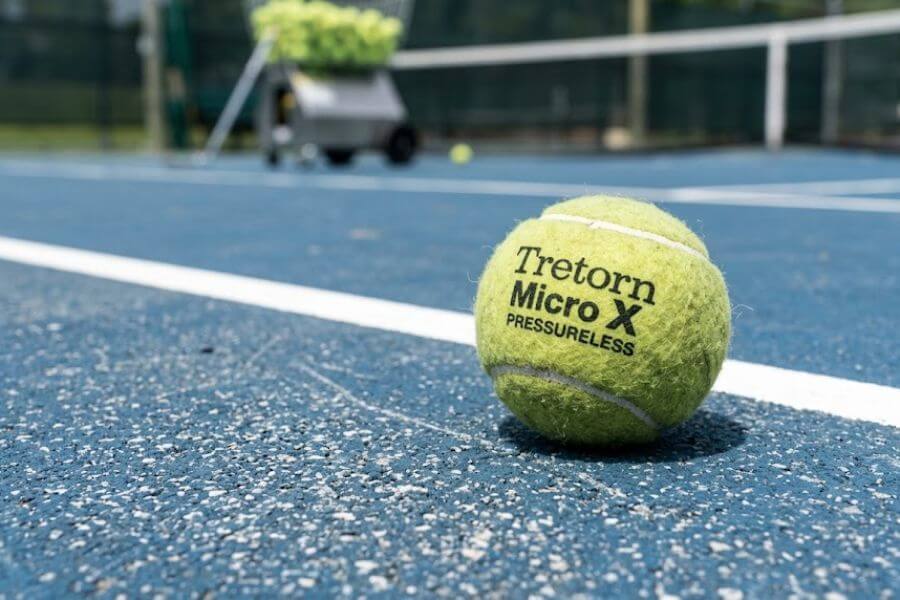
1. Tretorn Micro X
The Tretorn Micro X takes the top spot because it uses a patented design filled with hundreds of millions of microscopic air cells rather than standard compressed air. This means the core will literally never go dead or lose its bounce, allowing you to use them in your machine for months or even years. The outer layer features a unique woven flexible felt that resists the aggressive grinding of ball machine wheels, ensuring the ball keeps its aerodynamic flight path over countless baseline drills.
2. Wilson Triniti Pro
Wilson engineered the Triniti Pro to solve the major complaint players have about traditional training balls, which is that they feel heavy and hard like rocks when hitting your racket. By using an advanced plastomer material in the core walls, this ball maintains a lively, standard bounce while remaining completely unpressurized. The enhanced extra-duty felt grips the hard court beautifully and does not fluff up excessively, keeping your machine feeding smoothly without clogging the internal mechanisms.
3. Pro Penn Marathon Extra Duty
If you absolutely insist on using a traditional pressurized ball for your practice, the Pro Penn Marathon is the longest-lasting option on the market. Penn packs these balls with their proprietary premium woven felt and a reinforced core to combat the rapid pressure loss that kills normal tournament balls. They offer the exact weight, feel, and spin response you experience during competitive matches, though you will eventually need to replenish the pressure compared to the lifetime design of pressureless alternatives.
4. Dunlop Grand Prix Extra Duty
Dunlop has a legendary reputation for making heavy, robust tennis balls, and the Grand Prix Extra Duty lives up to that legacy on abrasive outdoor courts. This ball features a premium woven cloth combined with a specially formulated rubber core that gives you a solid, satisfying feel upon impact with your racket string bed. The extra-thick felt stands up remarkably well against the high-velocity spinning wheels of automated machines, making them a favorite for players focusing on deep, heavy baseline groundstrokes.
5. Spinfire Touch
Specially designed by a prominent ball machine manufacturer, the Spinfire Touch is a pressureless ball built specifically to mimic the soft, responsive feel of a fresh tournament ball. Because it relies on the elasticity of its rubber wall rather than internal air pressure, it will retain its signature bounce for its entire lifetime. The felt blend is uniquely tuned to resist shedding inside ball hoppers, meaning your machine stays clean of the typical green fuzz debris that can slowly ruin internal electronic sensors.
Finding the Best Training Setup
Investing in high-durability tennis balls completely transforms your solo training sessions from an expensive chore into a cost-effective workout. While pressurized options give you the ultimate tournament feel for a few sessions, switching to a micro-cellular or advanced pressureless ball will save you hundreds of dollars over a year of practicing. Pick the ball that matches your preference for feel or lifetime longevity, fill your hopper, and start dialing in your footwork and stroke mechanics with confidence.
Frequently Asked Questions
Why do standard pressurized tennis balls fail so quickly inside ball machines?
Standard pressurized balls rely on trapped gas inside the core to bounce, and every single strike from a ball machine wheel or impact on a hard court forces a small amount of that gas to escape through the rubber. Because machines strike the balls far more frequently than human players do, a standard can will go completely flat and useless after just a few hours of rapid feeding.
Can I safely mix different brands of durable tennis balls inside my machine hopper?
You should avoid mixing different brands or styles of tennis balls because each model has a slightly different weight, felt thickness, and bounce height. Mixing them causes the ball machine to shoot inconsistently, resulting in one ball flying deep past the baseline and the next one dumping straight into the bottom of the net.
How often do I need to wash or clean the felt on my practice balls?
You do not need to wash the felt, but you should regularly remove loose court debris, dirt, and excess moisture by wiping them down or letting them air dry completely before loading them into your machine. Wet or excessively dirty felt increases friction on the internal wheels, which can cause the machine to jam or launch the balls at erratic speeds.
Do pressureless tennis balls cause more arm fatigue or tennis elbow during long sessions?
Older styles of pressureless balls were notoriously stiff and could aggravate arm joints due to their thick rubber walls, but modern options like the Wilson Triniti Pro or Spinfire Touch use flexible materials to drastically soften the impact feel. To prevent arm fatigue during long machine sessions, focus on maintaining loose wrist mechanics and hitting the ball cleanly in the center of your racket strings.
When should I finally throw away a pressureless tennis ball?
You should replace a pressureless ball when the outer felt has completely worn away down to the smooth, black rubber core, even if the ball still bounces high. Without the fuzzy felt layer to create aerodynamic drag and friction against your strings, the ball will sail uncontrollably out of bounds and slide erratically across the hard court surface.