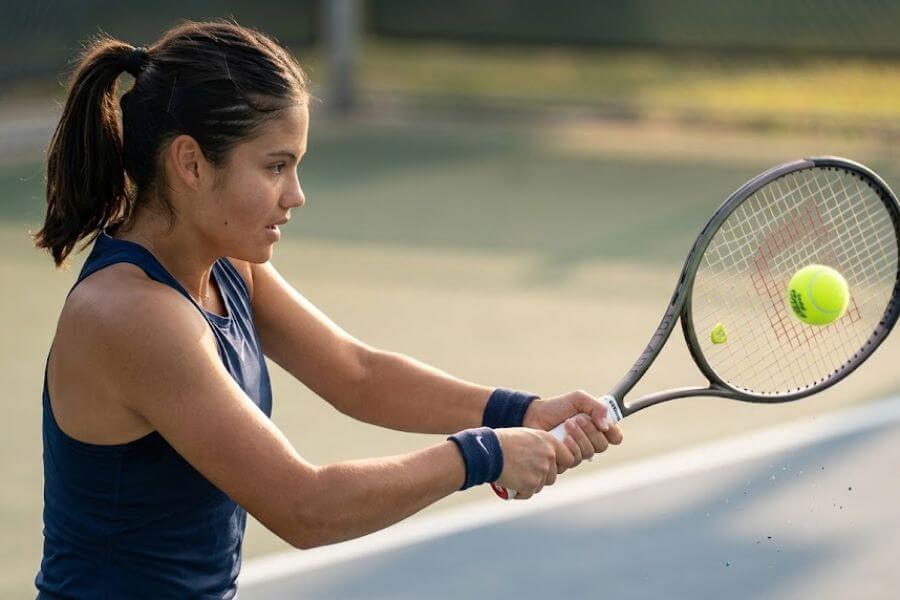
A solid two-handed backhand keeps you in the rally, but a weaponized backhand wins you the point. Many tennis players treat this shot as a purely defensive shield, using it just to safely guide the ball back over the net. To truly dominate the court, you need to transition from just surviving to actively attacking. This requires absolute control over your footwork, a perfectly timed shoulder turn, and explosive wrist snap. The following eight drills are designed to push your limits, challenge your muscle memory, and transform your backhand into a lethal offensive tool.
Quick Summary of the Hardest Backhand Drills
| Drill Name | Primary Focus | Difficulty Level |
| The Closed-Stance Medicine Ball Toss | Core Rotation and Power | High |
| Low-to-High On-The-Rise Striking | Ball Timing and Contact Point | Very High |
| Open-Stance Crosscourt Heavy Topspin | Hip Engagement and Rotation | High |
| The Deep-Corner Moving Retrieve | Footwork and Recovery Speed | Extreme |
| Inside-Out Backhand Drive | Shoulder Turn and Extension | High |
| High-Bouncing Shoulder-Level Drive | Contact Point and Finish | Very High |
| The Dead-Ball Drop-Hit Sprint | Generating Raw Acceleration | High |
| The Continuous Transition Swing Volley | Swing Path and Confidence | Extreme |
How We Ranked These Intense Drills
We did not just pick these drills at random. To find the toughest exercises that yield the biggest rewards, we analyzed how professional players build their groundstrokes. We ranked these specific drills based on three key factors:
- Physical Demand: How much core strength, lower body endurance, and explosive energy the drill requires.
- Technical Complexity: The precision needed in your racket face angle, timing, and foot spacing to hit a successful shot.
- In-Match Realism: How well the drill mimics the high-pressure, chaotic situations you face during a real competitive match.
1. The Closed-Stance Medicine Ball Toss
This drill forces you to generate power from your core rather than relying purely on your arms. You stand in a traditional closed hitting stance while a partner tosses a heavy medicine ball toward your backhand side. You catch the ball, coil your upper body tightly, and launch the ball back using only your hips and torso rotation. It is incredibly difficult because it exposes weak core muscles instantly. Master this, and your racket speed will skyrocket when you actually put a tennis racket back in your hands.
2. Low-to-High On-The-Rise Striking
Taking the ball on the rise robs your opponent of time, but it leaves you with zero room for error. In this drill, a partner or ball machine feeds deep, fast balls, and you must strike them immediately after they hit the court surface. You cannot back up, meaning you have to drop your racket head quickly and brush up cleanly. The timing is exceptionally tight, making it easy to hit the ball frame or send it flying into the back fence until you get the rhythm down.
3. Open-Stance Crosscourt Heavy Topspin
Most players prefer a closed stance on the backhand, but the modern game requires an open stance for quick recovery. You face the net with your feet wide apart, absorb a fast incoming ball on your left leg, and explode upward to whip the ball crosscourt. It challenges your balance and forces your non-dominant hand to do all the heavy lifting. Mastering this drill ensures you can hit scorching winners even when you are stretched wide out of position.
4. The Deep-Corner Moving Retrieve
This drill simulates the defensive nightmare of chasing down a perfect offensive shot from your opponent. You start in the middle of the court, sprint deep into the backhand corner, plant your outer foot, and try to drive a heavy ball back deep over the net. The difficulty lies in controlling your balance while moving backward and sideways at top speed. It drains your energy quickly and requires immense leg strength to stop your momentum and recover back to the center.
5. Inside-Out Backhand Drive
Hitting a backhand inside-out means changing the direction of the ball to send it into your opponent’s backhand corner. You must run around a ball centered on your body, establish a quick shoulder turn, and hold your disguise until the absolute last millisecond. It requires perfect spatial awareness so you do not crowd yourself. If your swing path is off by even a millimeter, the ball will sail wide into the alleys, making this a true test of racket face control.
6. High-Bouncing Shoulder-Level Drive
Dealing with high, looping topspin balls to the backhand is a universal struggle for tennis players. This drill feeds balls that bounce up near your shoulder, forcing you to drive forward through the ball rather than letting it push you backward. You have to jump slightly or use a high take-back to strike the ball at its apex. It is physically exhausting and requires immaculate timing to avoid hitting a weak, floating ball that your opponent can easily smash.
7. The Dead-Ball Drop-Hit Sprint
Generating your own pace on a ball with zero incoming speed is deceptively hard. You drop a tennis ball out of your hand, let it bounce once, and try to hit a baseline-to-baseline winner while immediately sprinting to the net. Because the ball has no energy of its own, you must use maximum wrist snap and violent racket head acceleration to create depth. It teaches your body how to step into the court and punish short, lazy balls during a match.
8. The Continuous Transition Swing Volley
The swing volley requires you to take a high, floating ball completely out of the air using your full groundstroke swing instead of a traditional block volley. A partner feeds high balls just inside the service line, and you must swing aggressively without letting the ball touch the ground. It is the ultimate test of confidence and hand-eye coordination. It ranks as the hardest drill because mistiming the swing by a fraction of a second results in an embarrassing miss, but mastering it allows you to completely take over the net.
Build Your Unstoppable Backhand
Transforming your backhand into a true weapon takes time, sweat, and plenty of patience. These eight drills are meant to challenge you, so do not get discouraged if you miss a lot of shots when you first start practicing them. Focus on consistent footwork, keep your non-dominant hand active, and practice regularly. As your muscle memory adapts, you will notice your backhand transforming from a safe defensive shot into an aggressive weapon that terrifies your opponents.
Frequently Asked Questions
Which tension setting on my tennis strings helps optimize a two-handed backhand for power?
Lowering your string tension by a few pounds gives you a larger sweet spot and more trampoline effect, which naturally boosts power on your backhand. If you struggle to generate depth on these hard drills, dropping your tension to around 48 to 52 pounds can help you get that extra depth without swinging harder.
Should my dominant hand or non-dominant hand grip the racket tighter during these drills?
Your non-dominant hand, which sits on top of the grip, should actually do most of the pulling and driving work. Think of your two-handed backhand as a left-handed forehand if you are a right-handed player. Keep your bottom dominant hand relatively loose to allow your wrists to snap naturally through the contact zone.
How do I prevent wrist pain when practicing the high-bouncing shoulder-level drive?
Wrist pain usually happens when you try to muscle the ball using only your arms instead of turning your shoulders. To protect your joints, make sure you take a complete shoulder turn early and hit the ball well in front of your body so your larger core muscles absorb the impact.
Can I practice these advanced backhand variations effectively using a basic tennis wall?
Yes, a tennis wall is excellent for practicing repetitive rhythm, especially for on-the-rise striking and dead-ball drop hits. Just make sure you stand close enough to the wall so the ball returns to you quickly, forcing you to prepare your racket immediately after your finish.
Is it better to use a loopier take-back or a straight back-swing for aggressive shots?
A straight, compact back-swing is generally better for the toughest drills like on-the-rise hitting because it minimizes extra movement. A loopier take-back can help create topspin on slower balls, but tight, fast shots require a short, efficient swing path to ensure clean contact.