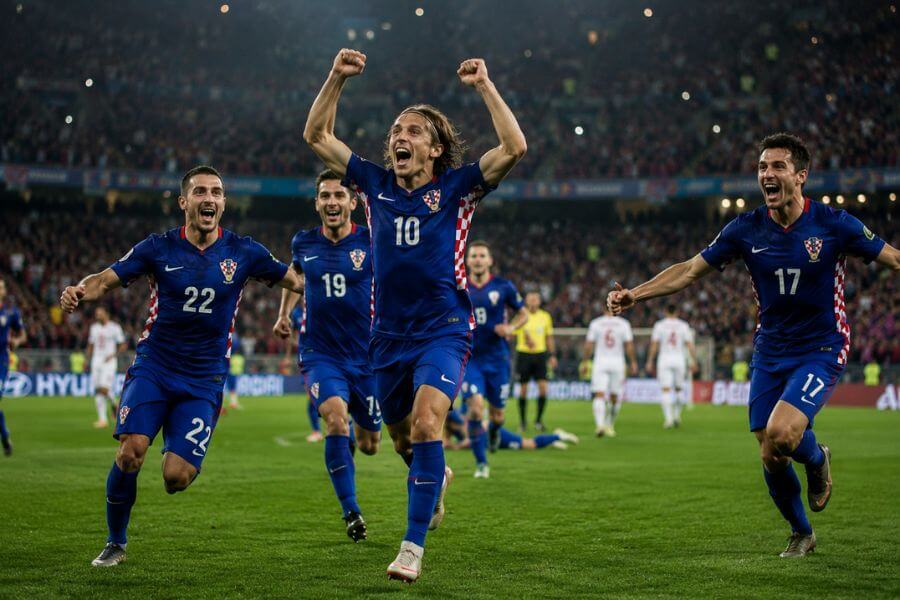
Summary of the Biggest World Cup Underdog Runs
| Number | Year | Team | How Far They Reached |
| 1 | 2022 | Morocco | Semi-Finals (Fourth Place) |
| 2 | 2002 | South Korea | Semi-Finals (Fourth Place) |
| 3 | 1994 | Bulgaria | Semi-Finals (Fourth Place) |
| 4 | 2002 | Turkey | Semi-Finals (Third Place) |
| 5 | 1998 | Croatia | Semi-Finals (Third Place) |
| 6 | 1966 | North Korea | Quarter-Finals |
| 7 | 1990 | Cameroon | Quarter-Finals |
| 8 | 2014 | Costa Rica | Quarter-Finals |
How We Ranked These Incredible Runs
Rankings like these require careful thought. We looked at how teams performed when nobody expected them to win. Here are the key factors we used to build this list:
- The Size of the Surprise: How low were the team’s expectations before the tournament started?
- The Power of the Opponents: Did the underdog beat giant, world-class teams along the way?
- The Deepness of the Run: How close did the team get to the final match?
- The Quality of Play: Did they win by luck, or did they show real skill and strategy?
- Historical Context: Had this country ever done well in soccer history before this moment?
1. Morocco (2022)
The 2022 World Cup in Qatar gave us the greatest underdog story in modern soccer history. Before this tournament, no African nation had ever reached the semi-finals of a World Cup. Morocco changed everything. They entered a very difficult group with Croatia and Belgium, two giant teams from Europe. Most people thought Morocco would go home early, but they won their group without losing a single game.
Their success was built on a defense that felt like a brick wall. Led by coach Walid Regragui, Morocco played with incredible discipline. They kept clean sheets against some of the best attackers in the world. In the round of sixteen, they faced Spain, a team famous for keeping the ball. Morocco defended for one hundred twenty minutes and then won in a dramatic penalty shootout.
The magic did not stop there. In the quarter-finals, they played Portugal, a team loaded with superstar players. Morocco scored a magnificent header before halftime and held onto their lead with pure heart and soul. Millions of fans around the world celebrated with them. Even though they lost to France in the semi-finals, this Moroccan team became heroes. They proved that a well-organized team with massive belief can break history.
2. South Korea (2002)
South Korea co-hosted the 2002 World Cup with Japan, and the home fans created an energy that the world will never forget. Before 2002, South Korea had played in five World Cup tournaments but had never won a single match. Under Dutch coach Guus Hiddink, the team went through intense physical training. They became a super-fast group of players who could run for ninety minutes without getting tired.
They started by beating Poland and tying with the United States. Then, they knocked out a very strong Portuguese team to win their group. The knockout stage is where the real drama happened. South Korea faced Italy in the round of sixteen. Italy was full of famous players, but South Korea fought hard and scored a golden goal in extra time to win.
In the quarter-finals, they faced Spain. The match was intense and went to a penalty shootout. The Korean players showed nerves of steel, scored all their penalties, and advanced to the semi-finals. Their run ended against Germany, but their fourth-place finish remains a legendary achievement. The sea of fans in red shirts cheering in the streets showed how soccer can unite an entire country.
3. Bulgaria (1994)
Bulgaria went to the 1994 World Cup in the United States with a terrible record. They had played in sixteen World Cup games across several decades and had never won a single one. It looked like history would repeat itself when they lost their opening match to Nigeria by three goals. However, Bulgaria had a secret weapon named Hristo Stoichkov, a brilliant forward with an amazing left foot.
Bulgaria bounced back by beating Greece and then pulled off a huge upset against Argentina. That victory gave them the confidence they needed. In the knockout rounds, they beat Mexico in a tense penalty shootout to set up a quarter-final match against Germany. Germany was the defending world champion and the heavy favorite to win.
The Germans took the lead with a penalty kick, and it looked like Bulgaria was finished. But in a span of just three minutes, the game flipped completely. Stoichkov scored a beautiful free kick, and then Iordan Letchkov scored a diving header. Bulgaria won the match and shocked the world. They eventually lost to Italy in the semi-finals, but Stoichkov finished as the joint-top scorer of the tournament, and Bulgaria became a world power for one summer.
4. Turkey (2002)
The 2002 World Cup was truly the tournament of the underdogs, and Turkey was another team that shocked everyone. Turkey had only qualified for the World Cup once before, way back in 1954. Nobody expected them to do much in Korea and Japan. They started in a group with Brazil, and even though they lost that first game, they showed they could compete with the very best.
Turkey advanced past the group stage after beating China. In the round of sixteen, they faced the co-hosts Japan. Turkey scored early and defended their lead with great physical strength. In the quarter-finals, they played against Senegal, who was also having a magical run. Turkey scored a golden goal in extra time to advance to the final four.
Their dream ended in the semi-finals when they lost a close match to Brazil for the second time in the tournament. However, they recovered quickly to play South Korea in the third-place match. Turkey won that final game, and Hakan Sukur scored the fastest goal in World Cup history just eleven seconds after kickoff. Turkey proved that passion and tactical teamwork can take a nation very far.
5. Croatia (1998)
Croatia became an independent nation in the early 1990s, and the 1998 World Cup in France was their very first time playing in the tournament. Because they were a new country, most soccer fans did not know what to expect. But Croatia had a generation of players who were technically gifted and very hungry for success. Their star forward was Davor Suker, a player who could score from almost any angle.
Croatia played smart soccer in the group stage, beating Jamaica and Japan to advance. In the round of sixteen, they beat Romania with a calm penalty from Suker. That set up a massive game against Germany in the quarter-finals. People thought the experienced German team would easily beat the newcomers, but Croatia had other plans.
They played a perfect match and defeated Germany by three goals to zero. It was one of the most stunning results in World Cup history. Croatia led against France in the semi-finals but eventually lost to the home team. Still, they beat the Netherlands to win third place, and Suker won the Golden Boot as the tournament’s top scorer. They put their new nation on the global sports map.
6. North Korea (1966)
The 1966 World Cup in England featured one of the earliest and most mysterious underdog stories ever. North Korea qualified for the tournament, but almost nobody in Europe knew anything about their players. They lost their first game to the Soviet Union and then managed to get a draw against Chile. Their final group game was against Italy, one of the biggest giants in world soccer.
Everyone expected Italy to win by many goals. Instead, North Korea played a fast, high-energy style that confused the Italian stars. Just before halftime, Pak Do Ik scored a low shot into the corner of the net. North Korea defended like crazy for the rest of the game and won one to zero. Italy was knocked out, and their fans were furious.
North Korea moved to the quarter-finals to play Portugal. The miracle looked like it would continue when North Korea scored three goals in the first twenty-two minutes of the match. However, Portugal had a legendary player named Eusebio, who scored four goals to lead a comeback. North Korea lost five to three, but their incredible upset against Italy remains an all-time classic moment.
7. Cameroon (1990)
The 1990 World Cup in Italy opened with what many people still call the biggest shock in soccer history. Cameroon faced Argentina in the very first game of the tournament. Argentina had Diego Maradona, the best player in the world, and they were the defending champions. Cameroon was a team of players who mostly played in lower leagues.
Cameroon played an aggressive, physical game to stop Maradona. They even had two players sent off with red cards, meaning they finished the game with only nine players. Despite this disadvantage, Francois Omam-Biyik scored a header that slipped under the Argentine goalkeeper. Cameroon held on for a historic one to zero win.
They did not stop there. Cameroon won their group and beat Colombia in the round of sixteen, thanks to two goals from thirty-eight-year-old Roger Milla. Milla became famous for his dancing celebrations at the corner flag. Cameroon reached the quarter-finals and almost beat England, leading late in the game before losing in extra time. They changed the world’s view of African soccer forever.
8. Costa Rica (2014)
When the draw for the 2014 World Cup in Brazil came out, everyone felt sorry for Costa Rica. They were placed in Group D with Uruguay, Italy, and England. Those three opponents had won a combined total of seven World Cup trophies. Experts predicted that Costa Rica would lose all three games and go home with zero points.
Instead, Costa Rica shocked the soccer world. In their first game, they fell behind against Uruguay but fought back to win three to one. Next, they defeated Italy one to zero with a fantastic header from Bryan Ruiz. They then tied with England to finish at the top of the group of death. Their defense was incredible, and goalkeeper Keylor Navas made world-class saves in every match.
In the round of sixteen, Costa Rica played with ten men for a long time against Greece but won after a dramatic penalty shootout. They reached the quarter-finals against the Netherlands. They held the powerful Dutch offense to a zero-zero tie for one hundred twenty minutes before finally losing on penalties. Costa Rica showed that unity can overcome any group of superstars.
Conclusion
The World Cup is the ultimate stage for soccer, and while the biggest countries often win the trophy, it is the underdog stories that stay in our hearts. Teams like Morocco, South Korea, and Costa Rica remind us why we love sports. They show us that money and fame do not always win matches. With hard work, great coaching, and a shared belief, any group of players can shock the world and create history.
Frequently Asked Questions
What happens to players from underdog teams after a great World Cup run?
Many players see their lives change completely after a successful tournament. Big European clubs constantly look for fresh talent at the World Cup. When a small team does well, its top players often get expensive transfer deals to play in richer leagues like the English Premier League, Spanish La Liga, or Italian Serie A.
Do underdog teams get prize money for going far in the tournament?
Yes, FIFA rewards every nation based on how far they advance in the World Cup. The deeper a team goes, the more millions of dollars their national soccer federation receives. This money is very important for smaller countries because they can use it to build better stadiums, improve youth training facilities, and grow the sport at home.
Why do underdog teams seem to defend more than they attack?
Smaller teams often have fewer superstar attackers compared to giant nations. To balance this out, coaches focus on heavy defensive organization. It takes less individual star power to defend as a compact unit than it does to break down a defense with creative passing. Underdogs rely on this defensive discipline and look for quick counter-attacks or set pieces to score goals.
Has an underdog country ever actually won the entire World Cup?
No true underdog has ever won the modern World Cup trophy. The tournament has almost always been won by a small group of traditional soccer superpowers from Europe and South America. While underdogs often reach the quarter-finals or semi-finals, winning the final requires a depth of talent and experience that only the biggest nations have managed to maintain.
How does hosting the World Cup help an underdog team perform better?
Hosting a tournament provides a massive advantage for any team. The players do not have to travel long distances; they are used to the local weather, and they play in front of stadium crowds that are completely on their side. This intense home fan support creates a high-energy environment that can lift the players’ energy levels and put extra pressure on their opponents.