Quick Summary Table
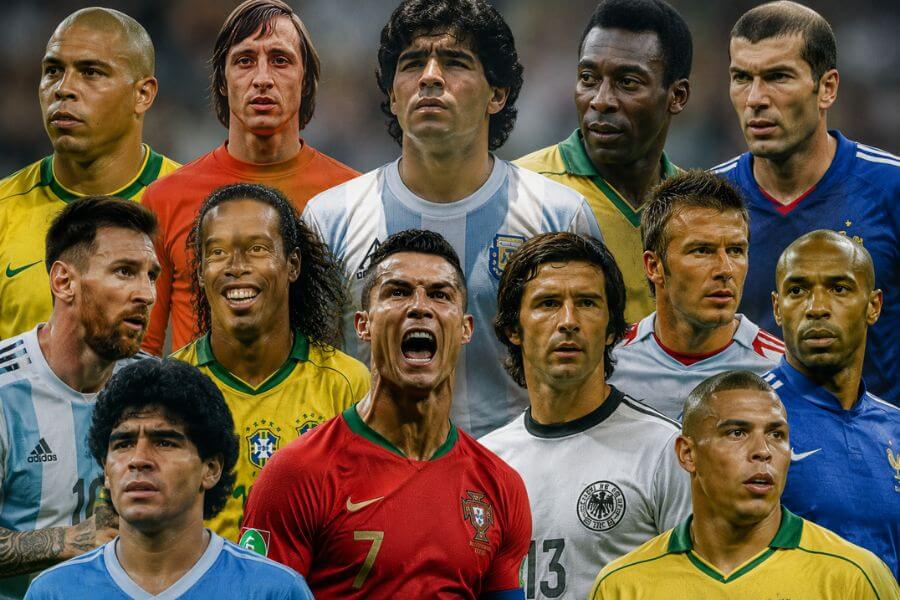
| Rank | Player | Country | World Cup Titles | Best Tournament Year |
| 1 | Pele | Brazil | 3 | 1970 |
| 2 | Diego Maradona | Argentina | 1 | 1986 |
| 3 | Lionel Messi | Argentina | 1 | 2022 |
| 4 | Ronaldo | Brazil | 2 | 2002 |
| 5 | Zinedine Zidane | France | 1 | 1998 |
| 6 | Franz Beckenbauer | Germany | 1 | 1974 |
| 7 | Miroslav Klose | Germany | 1 | 2014 |
| 8 | Kylian Mbappe | France | 1 | 2018 |
| 9 | Gerd Muller | Germany | 1 | 1974 |
| 10 | Garrincha | Brazil | 2 | 1962 |
| 11 | Cafu | Brazil | 2 | 2002 |
| 12 | Lothar Matthaus | Germany | 1 | 1990 |
| 13 | Just Fontaine | France | 0 | 1958 |
| 14 | Paolo Maldini | Italy | 0 | 1994 |
| 15 | Romario | Brazil | 1 | 1994 |
How We Ranked These
To find the most iconic players, we looked at how they performed on the biggest stage in sports. We used a strict list of rules to build this order. Here are the key factors we used to rank these players:
- Trophies Won: Winning the big gold cup matters more than anything else. Players who led their teams to victory receive the highest marks.
- Individual Awards: We looked at players who won the Golden Ball for the best player or the Golden Boot for the top goal scorer.
- Big Match Moments: Scoring goals or making saves in finals and semi-final matches gives players a much higher rank.
- Longevity and Statistics: Players who performed well across three or four different tournaments earned extra points.
- Cultural Impact: We chose players who created unforgettable moments that fans still talk about today.
1. Pele
Pele is the ultimate king of soccer history. You cannot think about the tournament without thinking about his yellow Brazil jersey. He is the only player to win three separate titles, an achievement that feels impossible to match.
He first showed his magic to the world in 1958 when he was only 17 years old. He scored a famous hat-trick in the semi-final and two more goals in the final match against Sweden. His mix of speed, amazing control, and smart passing changed the way people played the sport.
In 1970, Pele returned to lead one of the greatest teams ever built. His beautiful header in the final against Italy showed his incredible leaping ability. He finished his career with 12 goals in just 14 matches, making him the most legendary figure to ever step on the grass.
2. Diego Maradona
Diego Maradona played with a level of passion that moved an entire nation. The central point of his legacy is the 1986 tournament in Mexico. During that month, he single-handedly carried Argentina to the trophy with some of the most famous moments in sports history.
In a single game against England, Maradona showed both sides of his character. First, he scored the infamous hand-assisted goal that became known around the world. Just minutes later, he ran past five different players from the halfway line to score the goal of the century.
Maradona was not just about skill. He possessed a fierce competitive spirit that made his teammates play better. He reached another final in 1990, proving that his leadership could carry a team through the toughest situations.
3. Lionel Messi
Lionel Messi spent his career chasing the one trophy that always stayed out of his reach. He played in five different tournaments, experiencing deep heartbreak along the way. Everything changed during his legendary run in 2022.
In that winter tournament, Messi played like a man on a mission. He scored in the group stage, the round of 16, the quarter-final, the semi-final, and twice in the final match against France. His vision allowed him to make passes that normal players could not even see.
By lifting the trophy, Messi completed his soccer journey. He holds the record for the most appearances in history. His ability to control the pace of a game with small touches makes him a true modern icon.
4. Ronaldo
Ronaldo Nazario, often called the phenomenon, is the greatest central striker to ever play in the tournament. His story is one of ultimate survival and redemption. In 1998, he won the award for the best player but suffered a medical issue right before losing the final.
Four years later, Ronaldo returned with a unique haircut and a point to prove. He dominated the 2002 tournament in South Korea and Japan, scoring eight goals. He scored both goals in the final match against Germany to secure the trophy for Brazil.
Ronaldo combined scary power with lightning speed and step-over skills that confused defenders. He finished his tournament career with 15 goals, making him a true nightmare for goalkeepers.
5. Zinedine Zidane
Zinedine Zidane was a midfield artist who saved his best performances for the absolute biggest nights. In 1998, he became a national hero in France by scoring two powerful headers in the final match against Brazil to win the trophy on home soil.
Zidane controlled the center of the field with grace and power. In 2006, he came out of retirement to put on another masterclass. He carried an older French team past heavy favorites like Brazil and Spain, winning the tournament’s best player award.
His career ended with a shocking red card in the 2006 final, but that dramatic moment only adds to his legendary story. He remains the standard for midfield excellence under extreme pressure.
6. Franz Beckenbauer
Franz Beckenbauer invented a completely new way to play soccer. Known as the Emperor, he played as a defender who could move forward and start attacks with beautiful outside-of-the-foot passes.
He played in the 1966 final and performed bravely with a broken collarbone in 1970. His golden moment came in 1974 when he captained West Germany to a victory over a highly-favored Netherlands team.
Beckenbauer was a true boss on the field, organizing his teammates with quiet confidence. He later won the tournament as a manager, cementing his place as one of the smartest minds the sport has ever seen.
7. Miroslav Klose
Miroslav Klose might not have the flashy dribbling skills of other players on this list, but his efficiency is unmatched. Over four different tournaments, the German forward became the all-time top goal scorer with 16 goals.
Klose was a master of positioning and heading. He scored five goals in 2002, five more in 2006, four in 2010, and two in 2014. He always timed his runs perfectly to be in front of the net at the right moment.
He helped Germany reach at least the semi-finals in every tournament he played, finally lifting the gold trophy in 2014. His famous front-flip celebrations became a regular sight for soccer fans.
8. Kylian Mbappe
Kylian Mbappe is the youngest player on this list, but his achievements are already historic. As a 19-year-old in 2018, his incredible speed tore teams apart. He scored a brilliant goal in the final against Croatia to become the first teenager since Pele to score in a final.
In 2022, Mbappe took his game to an even higher level. In the final match against Argentina, he scored a stunning hat-trick to keep France alive in the greatest game ever played.
He won the Golden Boot in 2022 and already has 12 total goals. With plenty of years left in his career, he is on track to break every single record in the book.
9. Gerd Muller
Gerd Muller was nicknamed the bomber because of his explosive scoring habits. He did not care about looking stylish; he only cared about putting the ball past the goal line. He possessed an amazing ability to turn and shoot in crowded penalty areas.
In the 1970 tournament, Muller was completely unstoppable. He scored 10 goals in just six games to win the top scorer award.
Four years later, he scored four more times, including the winning goal in the 1974 final against the Netherlands. His career average of more than one goal per game makes him the most dangerous penalty box striker in history.
10. Garrincha
Garrincha was born with curved legs, but he used that unique physical trait to become the greatest dribbler in soccer history. When Pele got injured early in the 1962 tournament, Garrincha stepped up to carry Brazil.
He played with a sense of fun, constantly tricking defenders with body swerves before blasting down the wing. He scored crucial goals in the quarter-final and semi-final matches of 1962.
Fans loved him because he played for pure joy. He won two trophies and proved that Brazil could win even without their biggest star.
11. Cafu
Cafu is the definition of energy and consistency. The Brazilian right-back achieved something that no other male player has ever done. He played in three consecutive final matches in 1994, 1998, and 2002.
Cafu ran up and down the sideline for 90 minutes without ever looking tired. He defended with intelligence and provided excellent crosses for his strikers.
As the captain in 2002, he stood on top of the announcer table to lift the trophy into the sky. His smiles and endless energy represent the happy style of Brazilian soccer.
12. Lothar Matthaus
Lothar Matthaus was the ultimate midfield engine for Germany. He played in five different tournaments between 1982 and 1998, showing incredible staying power at the highest level.
Matthaus could mark the best attackers out of the game, but he could also run forward and score long-range goals. His finest hour came in 1990 when he captained West Germany to victory in Italy.
Diego Maradona once called Matthaus the toughest rival he ever faced. His leadership and tactical discipline kept Germany at the top for nearly two decades.
13. Just Fontaine
Just Fontaine holds a record that will likely never be broken as long as the sport is played. In the 1958 tournament in Sweden, the French striker scored an unbelievable 13 goals in just six matches.
Fontaine scored a hat-trick in his opening game and ended the tournament by scoring four goals against West Germany. He possessed a quick shot and a natural instinct for where the ball would bounce.
Injury shortened his career, so he only played in one tournament. However, that single month of perfection is enough to make him an everlasting icon.
14. Paolo Maldini
Paolo Maldini is the only pure defender on this list who never won the trophy, which shows just how incredible he was. The Italian left-back played with an elegance that made defending look like an art form.
Maldini rarely needed to slide tackle because his positioning was always perfect. He helped Italy reach the final in 1994 and the semi-finals in 1990 on home soil.
He played 23 total matches across four tournaments, rarely making a single mistake. His calmness under pressure earned him the respect of every attacker in the world.
15. Romario
Romario was a small striker with a massive personality and lightning-quick feet. He was the main man for Brazil during the 1994 tournament held in the United States.
Romario scored five goals during that hot summer, showing extreme coolness inside the box. He possessed a toe-poke shot that caught goalkeepers by surprise before they could move.
He won the Golden Ball as the best player of that tournament. His partnership with Bebeto brought the trophy back to Brazil after a long 24-year wait.
Frequently Asked Questions
Which player has scored the most goals in a single tournament game?
Oleg Salenko of Russia holds this unique record. He scored five goals in a single group stage match against Cameroon during the 1994 tournament in the United States. Despite his amazing performance that day, Russia did not progress past the first round of the competition.
Has any player ever won the tournament with two different nations?
Luis Monti is the only man to play in two final matches for two different countries. He played for Argentina in the 1930 final, where they lost to Uruguay. Four years later, he switched national teams and won the 1934 trophy while playing for Italy.
Who is the youngest player to ever score a goal in the tournament?
Pele holds the record as the youngest goal scorer in history. He scored against Wales in the 1958 quarter-finals when he was only 17 years and 239 days old. That goal started his path toward becoming a global sports star.
Which goalkeeper has kept the most clean sheets in history?
Peter Shilton of England and Fabien Barthez of France share this defensive record. Both goalkeepers managed to keep 10 clean sheets during their tournament careers. Barthez achieved his record while helping France win the trophy in 1998 and reach the final in 2006.
Who was the first player to receive a red card in a final match?
Pedro Monzon of Argentina was the first player to be sent off in a final game. He received a red card during the second half of the 1990 final against West Germany in Rome. Argentina went on to lose that match by a score of 1-0.